



AI search doesn’t “look up” an answer, it investigates through a mechanism called “query fan-out.” If you’re wondering what query fan out is, it’s the method AI uses to turn one question into a set of mini-questions, gather evidence, and summarize it. Once you get this, your SEO decisions get a lot clearer.
What Is Query Fan-Out in AI Search?
SEO used to be straightforward:
- Pick a keyword.
- Create a page for it.
- Rank.
- Win traffic.
That still works—but it’s no longer the whole story.
In an AI-driven search world, people don’t just type 1–3 words and click ten blue links. They ask full questions. They add constraints. They want a complete answer, fast. And most importantly: AI search doesn’t treat your question as one query.
It breaks it into many. That’s where query fan-out comes in.
Query fan-out is a technique used by AI search platforms where a single user query is automatically expanded into multiple related sub-queries. The system searches for each sub-query, then combines what it finds into one clear, useful response.
So if someone asks what query fan-out is, here’s the simplest explanation: It’s how AI search does the searching for you—and summarizes the best information into one answer.
Why Traditional SEO Alone Is Getting Outpaced
Traditional search tries to find the “best matching page” for a phrase. AI search tries to create the “best possible answer” for the intent behind the question. These are not the same thing.
A single prompt can contain multiple hidden tasks:
- define something
- compare options
- give a step-by-step plan
- provide warnings
- recommend tools
- explain tradeoffs
- personalize based on context
One page rarely covers all of that perfectly. So AI platforms use query fan-out to explore the missing angles and pull from sources that answer those smaller questions clearly.
In practice, ranking high on organic search results can help, but it’s not the only factor. AI systems often prefer content that is easy to extract and reuse, especially when it directly answers a specific sub-question.
How Query Fan-Out Works (In Plain English)
A user types: “How do I start eating healthy and avoid eating unhealthy foods?”
A query fan-out approach might expand this into sub-queries like:
- “how to eat healthy consistently”
- “simple healthy meal prep ideas”
- “how to reduce sugar cravings”
- “how to avoid fast food habits”
- “healthy snack swaps”
- “behavior change techniques for diet”
Then the model retrieves information across those angles and composes a single answer.
This is one of the biggest shifts: AI search isn’t just retrieving results—it’s assembling a response.
Query Fan-Out in Google AI Mode (And Why People Talk About It So Much)
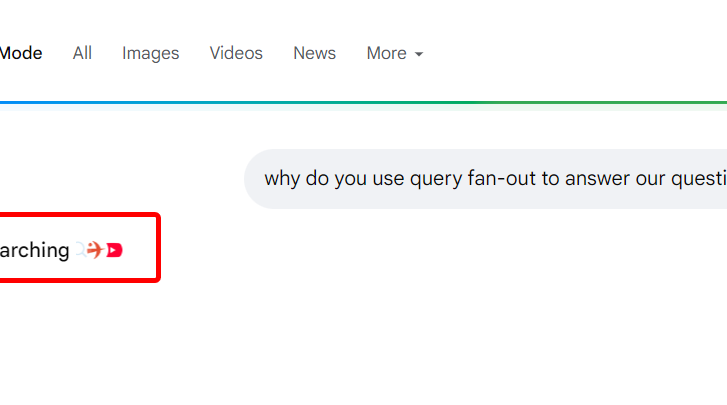
Google popularized the term “query fan-out” through Google AI Mode, where the system breaks complex questions into subtopics and runs multiple searches on the user’s behalf. Google has also discussed “Deep Search,” which takes this further by running many more searches to produce deeper, research-style responses.
But while Google made the label mainstream, query fan-out isn’t exclusive to Google. The same idea shows up across modern AI search and RAG (Retrieval-Augmented Generation) systems under names like query decomposition, multi-query retrieval, or RAG query transformation, all describing the same pattern:
Split or expand the prompt → retrieve across multiple angles → merge the best information into one response.
Platforms like Perplexity, for example, describe a real-time workflow of searching, gathering sources, and synthesizing them into an answer, often requiring the question to be broken into smaller parts.
The marketing implication is simple: AI isn’t “thinking” in one keyword anymore—it’s working through clusters of intent.
Why Do LLMs Use Query Fan-Out?
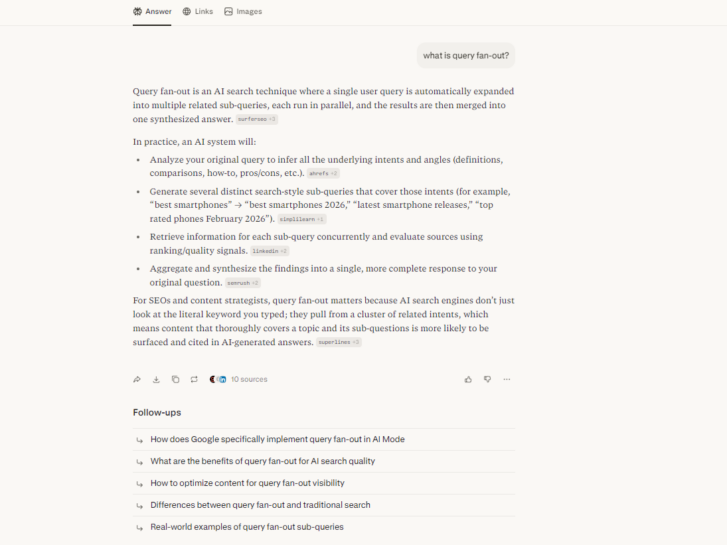
AI models fan out queries for a simple reason: One prompt can contain multiple user intents.
Even “best X” queries aren’t really one intent. They usually include:
- “best for beginners”
- “best value for money”
- “best premium choice”
- “best for a specific use case”
- “best alternative if you hate X feature”
So AI systems explore multiple angles and then present recommendations that fit different situations.
It also helps with highly specific questions where no single page has the perfect answer. Instead of relying on one “best result,” the AI can combine useful pieces from multiple sources into a more complete response.
What Query Fan-Out Helps AI Search Platforms Do
Query fan-out improves AI answers in a few practical ways.
1) Handle unclear or ambiguous queries
A lot of searches are vague by nature. Take the query “best insurance.” A traditional search engine might show a mixed set of results, like life, health, auto, and investment-linked plans, without knowing what you actually mean.
With query fan-out, the AI explores multiple interpretations in parallel, such as:
- health insurance vs life insurance
- families vs single professionals
- budget vs premium coverage
- coverage limits, exclusions, and claim process
- country- or city-specific options
Instead of committing to one guess, the system gathers the most relevant angles. Then it either presents a structured set of options or asks a follow-up question to narrow the answer.
2) Anticipate follow-up questions before the user asks them
A good human consultant doesn’t just answer the first question. They answer the next question the client is about to ask. AI systems do something similar through query fan-out.
If you ask: “How do I start lifting weights?”
The AI might also gather info about:
- beginner routines
- injury prevention
- nutrition basics
- rest and recovery
- home workouts vs gym workouts
That way, the final response is more useful and reduces the need for multiple searches.
3) Answer complex questions that need synthesis across multiple angles
Some questions can’t be solved by one perspective.
When I asked ChatGPT: “What should I do to make my website search friendly? How do I do SEO on my own?”
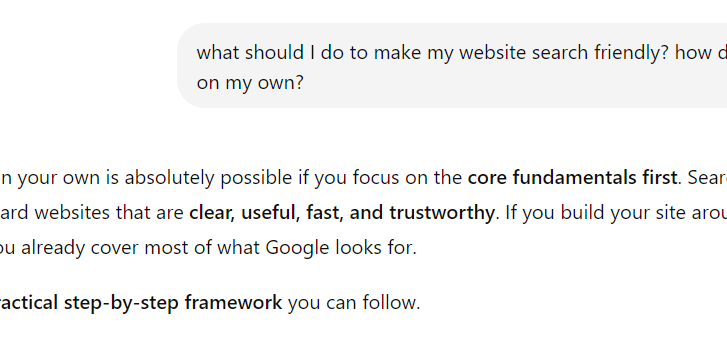
The system effectively broke that into a checklist of supporting topics, such as:
- what SEO is and how it works
- Google ranking factors
- SEO for beginners and DIY SEO steps
- keyword research and free keyword tools
- on-page SEO (title tags, meta descriptions, content structure)
- content clusters
- technical SEO basics
- link building strategies
…and so on.
That’s query fan-out in action. Multiple sub-questions power one structured response. Query fan-out helps the AI collect viewpoints and evidence across those angles so it can form a more balanced answer.
4) Personalize answers based on context
AI search platforms can also adjust how they fan out queries based on context.
For example, location can influence results:
- “best coffee shop” in Manila vs Cebu
- “best SEO agency” in the Philippines vs Singapore
And in some systems, user behavior and preferences can shape what the AI prioritizes, like budget vs premium, beginner vs advanced, or quick fix vs long-term plan.
This makes AI search feel more helpful—but it also means marketers can’t rely on a single “universal” keyword strategy anymore.
Why Query Fan-Out Matters for Marketing
Here’s the truth:
If the AI gives a complete answer, the user may not click anything.
So your visibility isn’t just about ranking pages anymore. It’s also about:
- getting mentioned in AI responses
- getting cited/linked as a supporting source
- being framed positively when AI compares options
This matters because AI answers can heavily influence decisions, especially for research, comparisons, and purchase planning. Take this example, where you can see several citations from marketers, agencies, and SEO companies:
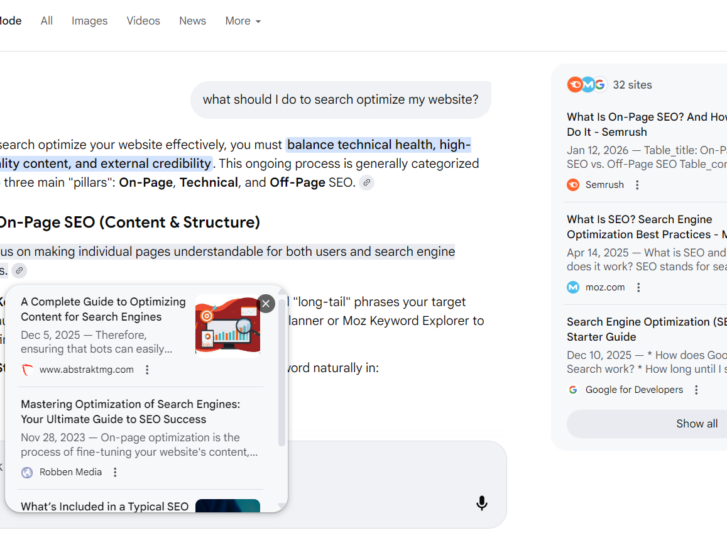
If your brand is absent from the fan-out sub-queries, you’re invisible in the final synthesized answer.
And worse: competitors can become the default “recommended” option simply because their content is structured better for AI extraction.
The Big Idea: Query Fan-Out = Topic Depth Wins (Not Just Keywords)
This is where old-school “one keyword = one article.” breaks down.
Because in a fan-out world, the AI might:
- pull your definition from one paragraph
- pull your steps from another page
- pull your comparison table from someone else
- pull your “common mistakes” section from a Reddit thread
- then cite whoever made each piece easiest to extract
So the new win condition becomes: Be the best source for the sub-answers. Not just the headline keyword.
How to Optimize for Query Fan-Out
If you want your content to show up when AI fans out, your goal is to become the “cleanest, clearest” source for multiple sub-queries.
1) Identify your core topics (not just keywords)
Start with topics directly tied to what you sell and what you want to be known for.
Think:
- problems you solve
- categories you’re in
- use cases customers ask about
- comparisons your buyers make
- objections your sales team hears weekly
This helps you influence AI answers at the exact moment buyers are deciding.
2) Build topic clusters that match the fan-out pattern
Query fan-out behaves like a cluster. So your content should too.
You need to make:
- A pillar page that covers the main concept broadly.
- Cluster pages that cover the subtopics deeply.
- Internal links that connect everything cleanly.
When AI fans out into sub-queries, your cluster content becomes eligible to be pulled into the response.
This topic-cluster approach is repeatedly recommended in modern AI visibility discussions because it builds topical authority and improves retrieval relevance.
3) Write in “semantic chunks” (so AI can lift answers cleanly)
AI systems retrieve and summarize best when your content is chunked into self-contained sections.
That means:
- short sections with clear subheadings
- direct answers early in the section
- context restated when needed
- minimal fluff
A great chunk can stand alone as a quoted or summarized answer.
If you want to win a query fan-out, you need dozens of “quotable chunks” across your site.
4) Define terms like you’re training an intern
If you introduce a concept, define it clearly. Don’t bury the definition in a story. Put it up front.
Example format:
- Definition
- Why it matters
- Example
- How to apply
That structure is extremely AI-friendly because it maps to retrieval + synthesis workflows.
5) Use schema markup to reduce ambiguity
Schema markups make your page more machine-readable.
If the AI is trying to answer sub-queries like:
- “price of X”
- “availability of X”
- “reviews of X”
- “event date”
- “FAQ about X”
Schema gives it clean fields to pull from.
This is consistently cited as helpful for AI interpretation and extraction, especially for product and business information.
A Quick Checklist for Your Writers (So This Actually Gets Done)
When your team writes a page that targets a topic likely to trigger fan-out, check these:
- Does the page answer the main question in the first 2–3 paragraphs?
- Does it include subheadings that match real “follow-up questions”?
- Does each section contain a direct answer, not just commentary?
- Are there comparison points, tradeoffs, and edge cases covered?
- Are there lists, steps, tables, or FAQs where relevant?
- Does it link to deeper cluster pages (and back to the pillar)?
- Does it have schema markups where it makes sense?
This is how you shift from “SEO copy” to “AI retrievable knowledge.”
Key Takeaway
So, what is query fan-out?
It’s the process where AI search turns one prompt into multiple sub-queries, gathers information across many angles, and merges it into a single answer.
And why does it matter?
Because AI visibility is increasingly earned at the sub-query level. If you want to win, you need content that covers topics deeply, answers follow-up questions clearly, and is structured so AI systems can reuse it.
Traditional SEO still matters. But in a world where AI does the searching for users, your content needs to be built for the fan-out.
The post What Is Query Fan-Out? The AI Search Technique Reshaping SEO and Content appeared first on SEO Services Agency in Manila, Philippines.


