



SEO in 2026 is starting to look a lot different from last year, and your data is probably already showing it — especially when you see traffic dips that don’t match your keyword growth, or CTR losses despite stable performance. Users are landing on your website without coming directly from Google, yet they already feel familiar with your brand, content, or even a specific page. This is where ChatGPT traffic becomes relevant.
As AI tools like ChatGPT change how people search and discover information, they’re also changing how users arrive at websites. Instead of clicking through traditional SERPs, users are getting recommendations, summaries, and direct answers from AI platforms.
In this guide, I’ll walk you through how to track ChatGPT traffic, measure ChatGPT traffic KPIs, and grow website traffic from ChatGPT based on what’s working in real-world SEO campaigns. This isn’t theory — this shift is already showing up in GA4 dashboards, particularly for brands where users rely on AI for research, comparisons, and decision-making.
Understanding ChatGPT as a Traffic Source
When we talk about ChatGPT traffic, it’s not just about clicks coming directly from AI tools. It’s about influence-driven traffic.
Unlike traditional search engines, ChatGPT surfaces information in a completely different way. Instead of presenting a list of blue links like Google Search, it delivers direct answers. These responses may include links, brand mentions, or summarized content pulled from multiple sources.
The key difference is this: not all visibility leads to a click.
In traditional search, visibility is closely tied to click potential. But in ChatGPT, visibility can happen without any immediate action. A user might see your brand mentioned, remember your solution, and come back later through a different channel.
That’s why I always break ChatGPT traffic into two types:
- Direct traffic. Actual clicks coming from AI tools. In GA4, this can appear as referral sources such as chatgpt.com (and similar AI platforms).
- Indirect traffic. The real multiplier. A user asks ChatGPT something like “best SEO agency in the Philippines,” sees your brand, then later searches your brand on Google or visits your site directly. The visit isn’t attributed to ChatGPT — but it was influenced by it.
Why ChatGPT Traffic Matters Today
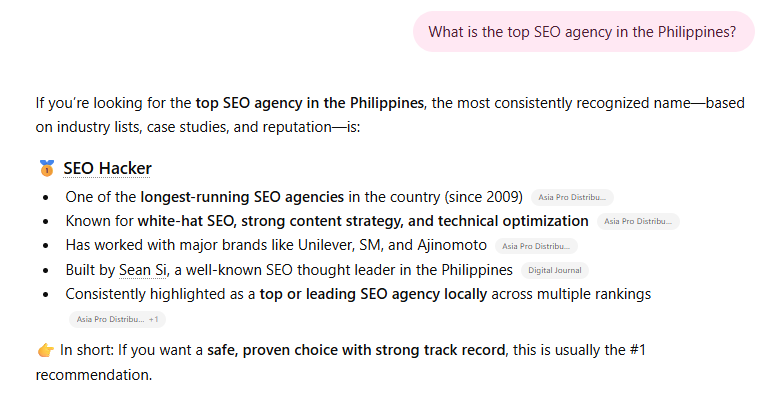
From what I’ve seen across different campaigns, user behavior is already shifting. More people are now using AI tools like ChatGPT to compare products or services, look for recommendations, and break down complex topics before making a decision.
In the Philippines, this shift is becoming more evident among SMEs and digital-first businesses. Instead of starting with Google Search, users increasingly begin inside AI platforms as a first touchpoint for discovery.
What makes AI-influenced traffic valuable is intent. These users are typically more informed, more specific, and often closer to converting.
You’ll also notice a difference in user behavior. These users tend to engage more. They explore multiple pages, spend more time on-site, and are less likely to bounce compared to traditional traffic sources.
Because of this shift, it’s no longer enough to rely on traditional SEO metrics alone. If AI is influencing how users discover and evaluate your brand, then it’s something you need to start measuring. The challenge now is understanding where this traffic shows up and how to properly track it.
How to Track ChatGPT Traffic
This is where most SEO professionals get stuck. The reality is: you won’t get perfect tracking. What you can get are directional insights that are strong enough to guide decisions and optimize performance.
Understand Where It Appears
ChatGPT traffic doesn’t always show up in one clear place. Instead, it’s usually spread across multiple channels:
- Referral traffic – Look for sources like chatgpt.com, perplexity.ai, and gemini.google.com
- Direct traffic – Often considered “dark traffic,” where no referrer is passed
- Organic search – Especially branded queries influenced by AI mentions
If you’re only looking at one channel, you’re missing the bigger picture. The key is to analyze these sources collectively.
Use Google Analytics 4 Properly
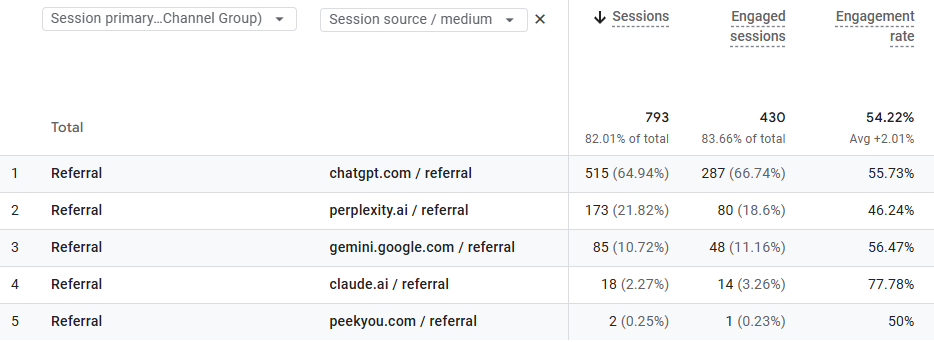
Inside Google Analytics 4 (GA4), one of the most effective approaches is creating a custom channel grouping for AI traffic.
I include known AI domains such as chatgpt, perplexity, and gemini, as well as other emerging AI platforms. From there, I monitor key metrics like sessions, engagement rate, and conversions.
You can also go deeper by analyzing behavior. For example:
- Do AI-driven users scroll further?
- Do they spend more time on key pages?
- Are they clicking your primary CTAs?
These patterns will help you understand the quality of AI-influenced traffic.
Use UTM Parameters Where Possible
This won’t apply to every scenario, but it’s useful for controlled testing.
If you’re sharing content that might get picked up by AI, like downloadable resources such as newsletters, content campaigns, or linkable AI-generated resources, you can add UTM parameters like: utm_source=chatgpt&utm_medium=ai&utm_campaign=traffic-test
It’s not a complete solution, but it gives you a cleaner signal and helps validate AI-driven traffic in specific campaigns.
Monitor Mentions and Citations
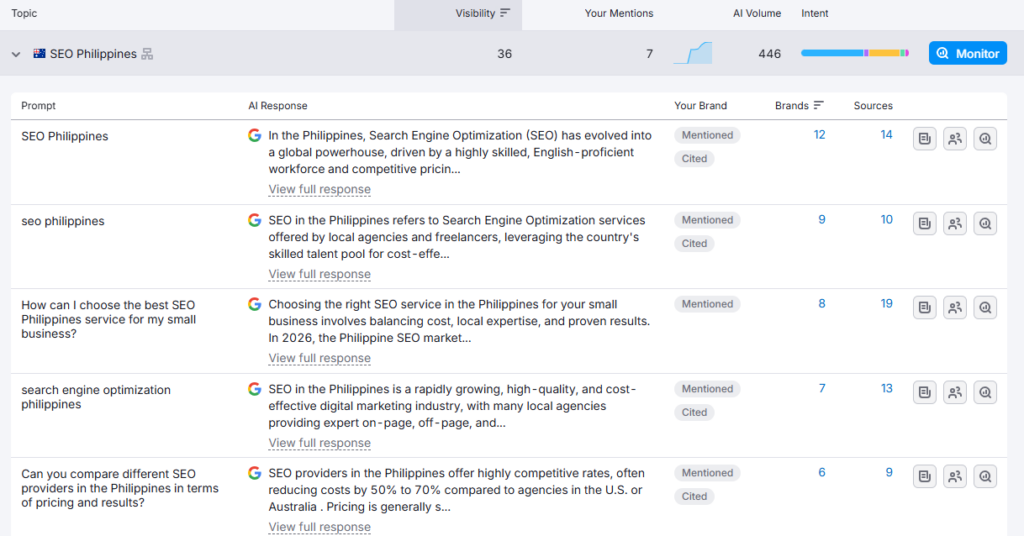
One of the most overlooked areas is tracking how often your brand is mentioned or cited in AI-generated responses.
Tools like Ahrefs and SEMrush can help identify visibility trends. From experience, once your content starts getting cited, you’ll typically see a lift in branded searches, followed by a gradual increase in direct traffic.
Compare Against Competitors
If your competitors are showing up more frequently in AI responses, that’s a clear signal.
Check what topics they’re ranking for, how their content is structured, and whether they’re getting cited externally. These insights can help you refine your own strategy and improve your chances of being surfaced in AI-driven results.
KPIs and Metrics that Matter
When it comes to tracking ChatGPT traffic, relying on a single metric won’t give you the full picture. The key is to look at performance from multiple angles: traffic, behavior, conversions, and visibility.
Traffic and Engagement
Start with the fundamentals. In GA4, monitor:
- Sessions from AI-related sources
- Engagement rate
- Pages per session
These metrics give you a baseline understanding of how much traffic AI is driving, and how users interact with your site once they land.
Conversions
Traffic is only valuable if it leads to results. With this, track leads and signups, as well as assisted conversions. Assisted conversions are especially important here, since AI-influenced users may not convert on their first visit but play a role somewhere in the customer journey.
Visibility
Beyond on-site metrics, you also need to measure how visible your brand is within AI responses like brand mentions and citation frequency.
The more often your content is referenced, the higher your chances of influencing user decisions.
Indirect signals
Some of the strongest indicators of ChatGPT impact are indirect like:
- Growth in branded search queries
- Trends in direct traffic
These signals often reflect users who discovered your brand through AI but returned through other channels.
Share of Voice
Share of voice (SOV) is the percentage of total visibility your brand earns compared to competitors across a defined topic set. For ChatGPT visibility, you’re measuring how often your brand is present in AI-influenced discovery—typically via proxy signals like SERP ownership, entity mentions, and citation footprint—because direct “ChatGPT rankings” aren’t consistently exposed in analytics.
How to Measure Visibility in ChatGPT
Even if ChatGPT doesn’t always send a measurable click, it still shapes discovery and decision-making—often invisibly.
That’s why measuring visibility in ChatGPT requires a blended approach: you track what you can attribute in GA4 (like AI referrals and downstream behavior), then you validate the bigger picture using SEO tool signals such as share of voice, brand mentions, and citation footprint.
When those visibility signals rise together, you’re not just “getting traffic”—you’re earning mindshare in the AI research layer that influences branded search, direct visits, and conversions.
What Does “Visibility in ChatGPT” Mean?
Visibility in ChatGPT is the extent to which your brand shows up inside AI-assisted research, either as a cited source, a named option, or a referenced perspective when users ask decision-stage questions.
Since this presence isn’t captured by a single “rankings” report, the most practical way to measure it is to combine trackable AI referral behavior with visibility indicators you can benchmark against competitors (like share of voice and citation signals).
Can You Measure ChatGPT Visibility Directly?
Not consistently. Most teams cannot measure “ChatGPT rankings” the same way they measure Google rankings. Instead, you measure visibility using:
- AI referral signals in GA4
- SEO & AEO tool proxies that reflect the likelihood of being mentioned or cited by AI—especially share of voice, brand mentions, and authority signals.
So the goal isn’t perfect attribution. The goal is repeatable measurement you can optimize month over month.
How Do You Measure Share of Voice for ChatGPT-Style Queries Using an SEO Tool?
Several SEO tools now have AEO capabilities. If your tool has features for tracking visibility on ChatGPT, this is what you need to do.
Create an “AI Keyword Set.”
Build a keyword set that mirrors how people prompt ChatGPT (comparisons, “best of,” pricing, decision questions). Use prompts that match real AI-style searches, such as:
- “best [service] in [location]”
- “[service] pricing Philippines”
- “[brand] vs [brand]”
- “how to choose a [service provider]”
Assign competitors per topic set.
Measure against the brands that compete for the same decision-stage queries.
Track SOV monthly using your tool’s visibility score or proxy metrics:
- % of keywords in Top 3 / Top 10
- visibility index (if your tool provides it)
Segment by intent (informational vs comparative vs transactional).
This tells you where you’re visible in the decision journey, not just whether you “rank.”
How do you turn share of voice and mention data into an action plan to increase ChatGPT visibility?
Identify where you’re losing share of voice and where competitors are earning citations, then build “answer-first” content assets and authority signals to close the gap—especially for high-intent prompts like comparisons, pricing, and selection guides.
Simple action loop (do this monthly):
- Choose 10–30 AI-style queries where your SOV is weak.
- Review who owns visibility (and what pages they use).
- Publish a better structured answer asset (clear H2s, Q&A blocks, decision criteria, proof).
- Earn citations to it (PR, partnerships, outreach, linkable assets).
- Re-check SOV + mentions and tie it back to GA4 outcomes.
How to Grow Traffic from ChatGPT
This is where strategy really comes in. Growing ChatGPT traffic isn’t just about ranking. It’s about making your content easy for AI to understand, extract, and recommend.
- Structure content for AI extraction. Make your content easy to “lift” by using clear headings, concise answer blocks (around 40–60 words), and well-structured FAQ sections. The easier it is for AI tools like ChatGPT to extract your content, the higher your chances of being cited.
- Answer first, then expand. Prioritize direct answers instead of building up slowly. Start with a clear, concise response, then follow it with supporting details. This improves both user experience and AI readability.
- Target real prompts, not just keywords. AI queries are more conversational. Instead of focusing only on short keywords, align your content with how users actually ask questions, especially long-tail, intent-driven prompts.
- Strengthen your entity and authority. Ensure your brand is clearly defined across your website. Use structured data, consistent messaging, and strong topical authority so AI systems can better understand and trust your content.
- Earn third-party mentions. Visibility on authoritative websites increases your chances of being referenced by AI. This is where traditional SEO, particularly link building and digital PR, continues to be an effective SEO strategy.
Putting these strategies into practice makes it easier to align your content with how AI platforms surface and recommend information. Quick breakdown:
| Strategy | Expected Result |
|---|---|
| Structure content for AI extraction | Higher chances of being cited in AI responses |
| Answer first, then expand | Better readability and improved AI extraction |
| Target real prompts | Better alignment with conversational AI queries |
| Strengthen entity and authority | Increased trust and recognition by AI systems |
| Earn third-party mentions | Greater visibility and likelihood of AI references |
Challenges in Tracking ChatGPT Traffic
We’re still early in this space, which means tracking ChatGPT traffic comes with real limitations.
Attribution, in particular, is still messy. Not every AI-influenced visit is clearly identifiable. Many of these sessions show up as direct or organic traffic inside tools like GA4, making it difficult to isolate their true source.
Another challenge is the lack of prompt-level data. In most cases, we don’t know the exact query that triggered our content to appear in platforms like ChatGPT. This makes it harder to fully understand which topics or formats are driving visibility.
On top of that, AI platforms are evolving quickly. Features, behaviors, and even how content is surfaced can change within months, which means strategies that work today may not be as effective in the near future.
Because of these limitations, it’s best to treat ChatGPT as an assist channel rather than a primary traffic source for now. The goal is to gather directional insights, adapt quickly, and continuously refine your approach as the space matures.
Key Takeaway
ChatGPT traffic is no longer something we can ignore. It’s already influencing how users discover, evaluate, and choose brands, even in the local SEO landscape. Platforms like ChatGPT are becoming part of the user journey, influencing decisions long before a click happens.
The key is not to achieve perfect attribution, but to build a system where you can track, measure, and grow ChatGPT traffic over time.
At the end of the day, the approach remains the same as SEO: test, analyze, and refine. As you continue to optimize, you’ll begin to see how AI visibility translates into real business results, from stronger brand awareness to more qualified traffic and conversions.
The post ChatGPT Traffic Guide: How to Track, Measure, and Grow appeared first on SEO Services Agency in Manila, Philippines.


