



AI-powered marketing workflows are no longer about who has the best tools. Most teams already have access to similar models, similar automations, and similar “instant content” features. The advantage now belongs to leaders who can turn AI into a disciplined marketing system: clear strategy, clean inputs, strong editorial standards, and fast iteration without sacrificing brand voice. AI can multiply output, but proper leadership multiplies results.
Why this matters now
AI is already inside modern marketing workflows. Adoption has moved from “experiment” to “default.” The difference between teams that thrive and teams that stall is not access to tools. It is clarity of leadership and quality of execution systems. If you want a practical view of where AI actually helps (and where it does not), my guide on AI and SEO growth strategy breaks down the real-world applications.
Why AI Alone Isn’t the Competitive Advantage
If everyone can generate copy, images, ad variants, and campaign ideas in minutes, then speed becomes a baseline. When speed is the baseline, your differentiation becomes:
- Strategy quality – Knowing what to prioritize, what to ignore, and what to double down on.
- Judgment and taste – Knowing what “good” means for your brand. Knowing what is off-brand, risky, or low-converting even if it looks impressive.
- Operational discipline – Having workflows that turn drafts into publish-ready output consistently, not occasionally.
- Learning loops – Getting better every week. Capturing what works, codifying it, and scaling it across the team.
AI improves throughput. Competitive advantage comes from leadership decisions that shape what the AI produces and what the team ships.
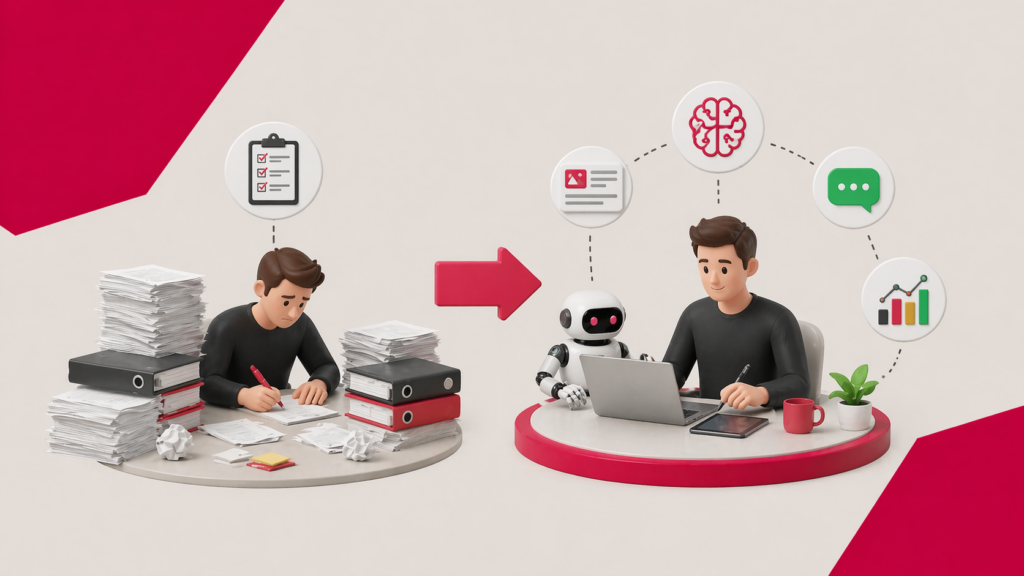
The Shift: From Manual Production to Human-Led AI Orchestration
Marketing roles are changing. The old model was task execution: write, design, schedule, report, repeat.
The new model is orchestration. Marketers direct systems and make higher-level calls:
- Defining the brief, angle, offer, and audience
- Setting constraints for brand voice, claims, compliance, and tone
- Producing multiple variants quickly through AI
- Selecting, refining, QA-ing, and publishing
- Measuring results and feeding learnings back into the system
This is the core of AI Marketing Leadership: leaders are not just approving work. They are designing an operating system where AI accelerates execution and humans protect strategy, quality, and alignment. This is also why planning content around outcomes matters more than volume, and why being intentional with how your AI is implemented in workflows becomes a stronger strategy than “just publish more.”
The Three Pillars of AI-Human Leadership
AI is the accelerator, not the driver. Teams win when leaders keep strategy human-led, build trust through clear rules, and set guardrails that protect quality as output speeds up.
1) You are still the strategist (AI is a research assistant, drafter, and multiplier)
The most common failure pattern is when leaders treat AI as a decision-maker.
AI is best used for:
- Rapid drafts and variations
- Summaries, outlines, and synthesis
- First-pass research and clustering
- Pattern spotting in large sets of data
Humans must own:
- Positioning and brand direction
- Priority and tradeoffs
- Final editorial approval
- Risk management (legal, compliance, reputational)
A simple rule: AI can propose. Humans decide.
2) Build trust before you build AI into the workflow
Tools do not fail because the model is broken. They fail because the team does not trust the output, the process, or the intent behind adoption.
Trust requires clarity in three areas:
- Why we are using AI
- What AI is allowed to do
- What AI is not allowed to do
3) Create clear guardrails and escalation paths
AI is strong at optimization. It is weak at knowing when to break rules or when context changes the “right” answer. Teams need predictable boundaries and a clear escalation rule for high-stakes content.

What High-Performing, AI-Powered Marketing Teams Look Like
High-performing teams do not “automate everything.” They combine human creativity with AI efficiency, then operationalize the combo.
1) Human creativity plus AI efficiency
AI increases volume and speed. Humans increase meaning, differentiation, and conversion power.
2) Clear roles focused on strategy, not just execution
When AI enters the workflow, roles must become clearer, not blurrier:
- Strategy Owner
- AI Operator / Workflow Owner
- Editor / QA Owner
- Channel Owner
3) Strong collaboration and feedback loops between people and systems
AI needs a learning system around it. Without that, output stays random.
What to institutionalize:
- A shared prompt library (by asset type)
- Brand voice rules (dos, don’ts, examples)
- A QA checklist (accuracy, tone, claims, CTA, formatting)
- Weekly review of wins and losses (what worked, why it worked)
- Monthly workflow review (what to keep, cut, improve)
If your team is trying to scale content across formats without sacrificing quality, the system on how to build a multimodal content strategy fits perfectly with this “orchestration” model.
Why Human-Centered Leadership Matters More Now
AI increases speed. Speed amplifies everything.
If leadership is unclear, AI creates faster confusion. If leadership is strong, AI creates faster learning and output.
Teams perform better when leaders provide:
- Trust (safe learning and transparent expectations)
- Clarity (standards, process, definition of “good”)
- Adaptability (iteration as default because tools keep changing)
How to Implement AI Marketing Leadership Without Chaos
Roll out AI through one repeatable workflow first, then standardize it with templates and QA. Assign clear owners (workflow + editorial), and measure cycle time plus revision rate so speed never trades off with quality.
Step 1: Start with the most repetitive process
Pick one workflow that drains time weekly. Improve it. Standardize it. Then scale to the next.
Step 2: Measure what matters, not just efficiency
Speed is not the only KPI. Track:
- Speed (cycle time)
- Quality (revision count, approval rate, performance lift)
- Team sentiment (confidence, stress, adoption)
When measurement gets messy because discovery is happening inside AI answers and new search surfaces, attribution in the age of AI answers is a solid reference point for how to think about performance without relying on outdated assumptions.
Step 3: Do monthly “what’s working” conversations
AI workflows degrade without maintenance because tools, prompts, and requirements change. A monthly review keeps the system sharp.
If you want a structured capability roadmap for being “AI-ready” in search and content, the AEO maturity model for AI-ready search visibility complements this leadership approach well.
What Kills AI Integration in Teams
These are predictable failure modes:
- Leaders disappear after implementation (no ownership)
- Leaders pretend the tool has no limits (overpromising destroys trust)
- Forced adoption without training and guardrails (mandates create resistance)
One simple way to protect quality while increasing output is to enforce a consistent QA standard before anything goes live. My 17-point pre-publish SEO content checklist is an easy internal standard to adopt even if your writers are producing first drafts with AI.
Key Takeaway
Do not start with “What AI tool should we buy?”
Start with this: What bottleneck is crushing output quality or team morale, and can AI reduce that bottleneck without lowering standards?
Solve that first. Then scale.
FAQ
Q: Won’t AI eventually replace my team members?
It will replace repetitive, low-judgment parts of the job. The people who win are the ones who learn to direct AI, edit AI, and make strategic calls with AI support. The risk is in being stuck in commodity execution only.
Q: How do I know if an AI tool is worth the investment?
Run a two-week trial with real work. Track hours saved, output quality, and team sentiment. If all three improve, you have a good, effective tool on your hands. If one drops, fix the workflow before you blame the tool.
Q: What if my team refuses to use the AI tools?
Treat that as data. It usually signals unclear value, missing guardrails, lack of training, or a newly established AI-powered workflow that does not match reality. Do your due diligence understand their hesitation to better address the friction. Do not rely on mandates.
Q: How do I measure whether AI Marketing Leadership is working?
Look for this combination: you ship more at the same time, quality stays stable or improves, and stress decreases. If output rises but stress and revision cycles rise too, leadership systems need work.
The post AI Marketing Leadership: How to Build High-Performing Human + AI Marketing Teams appeared first on SEO Services Agency in Manila, Philippines.


