



Understanding how to find AI visibility gaps starts with recognizing that modern search now happens in two layers. Traditional SEO still focuses on ranking in search engine results pages. But when users get answers directly from AI systems, two different practices come into play:
Answer Engine Optimization (AEO) helps your content get selected and cited inside AI-generated answers, while Generative Engine Optimization (GEO) focuses on shaping how generative systems understand your brand and synthesize information across multiple sources when producing responses.
When we talk about AI visibility, we’re referring to how often—and how accurately—your brand, content, products, services, or expertise show up inside AI-generated answers. The moment your content should be appearing for relevant prompts but isn’t, that’s where the real problem starts.
That brings us to the next question:
What Are AI Visibility Gaps?
AI visibility simply measures whether your brand and content are being mentioned, cited, or used inside AI-generated answers. The stronger and clearer your presence, the more likely AI systems are to surface when users ask relevant questions.
This can include:
- Mentions in AI-generated answers
- Citations in AI search tools
- Recommendations in conversational queries
- Inclusion in AI summaries
- Recognition as a trusted source
An AI visibility gap happens when your content should appear in these places but does not.
In other words, your website may be relevant. It may even rank well. But AI systems are choosing other sources instead.
Examples of AI Visibility Gaps
Here are a few common examples I see when auditing websites:
- Your website ranks organically but never appears in AI Overviews
- AI assistants cite competitors instead of your content
- Your brand is not recommended for high-intent prompts
- AI systems display outdated information about your company
- Your informational content receives traffic but little AI exposure
These gaps matter because search visibility is no longer limited to blue links. A brand can be visible in Google results but absent from the AI answer layer where users are increasingly making decisions.
Why AI Visibility Gaps Matter
If users keep seeing your competitors cited, summarized, or recommended by AI systems, those competitors start earning trust before users even compare websites.
Ignoring AI visibility gaps can lead to:
- Reduced organic discoverability
- Lower brand authority
- Decreased top-of-funnel visibility
- Fewer conversions from AI-assisted search journeys
- Competitive disadvantages in AI-driven search experiences
As AI search becomes more common, visibility inside AI systems may become just as important as traditional rankings.
The best time to start measuring it is now, before traffic drops or competitors take over the conversation.
The Evolution from SEO to AEO and GEO
Traditional SEO has always focused on rankings, clicks, and keyword optimization. Those fundamentals still matter. But now, they support a bigger goal: becoming a source AI systems trust when they generate answers.
That shift introduces two related—but different—layers of optimization: AEO focuses on making your content easier for AI systems to retrieve, extract, and cite when users ask questions. GEO focuses on improving how generative systems understand your brand and synthesize information across multiple sources when forming responses.
This means optimization now includes:
- Semantic relevance
- Entity relationships
- Conversational query matching
- Structured content formatting
- Trust and authority signals
This does not mean abandoning SEO. Strong technical SEO, useful content, clean site architecture, authoritative backlinks, and a helpful user experience all support AI visibility.
AEO and GEO are not replacements for SEO. They are the next layers built on top of it.
The Business Impact of AI Visibility
Strong AI visibility can improve:
- Brand awareness
- Lead generation
- Assisted conversions
- Customer trust
- Authority in competitive markets
If AI systems repeatedly mention your brand when users ask important industry questions, users begin associating your business with expertise and credibility. This matters especially for high-consideration purchases. When a potential customer asks an AI tool for recommendations, comparisons, or explanations, your brand needs to be part of that conversation.
Industries Most Affected by AI Search
AI visibility is especially important in industries where users actively research before making decisions:
- SaaS
- Healthcare
- Finance
- Legal services
- E-commerce
- B2B services
- Marketing agencies
- Local businesses
These industries often involve comparison, trust, risk, pricing, expertise, and long decision cycles. That is exactly the type of environment where AI-generated answers can influence user behavior. If your content is not being retrieved or cited, you are leaving a lot of visibility on the table.
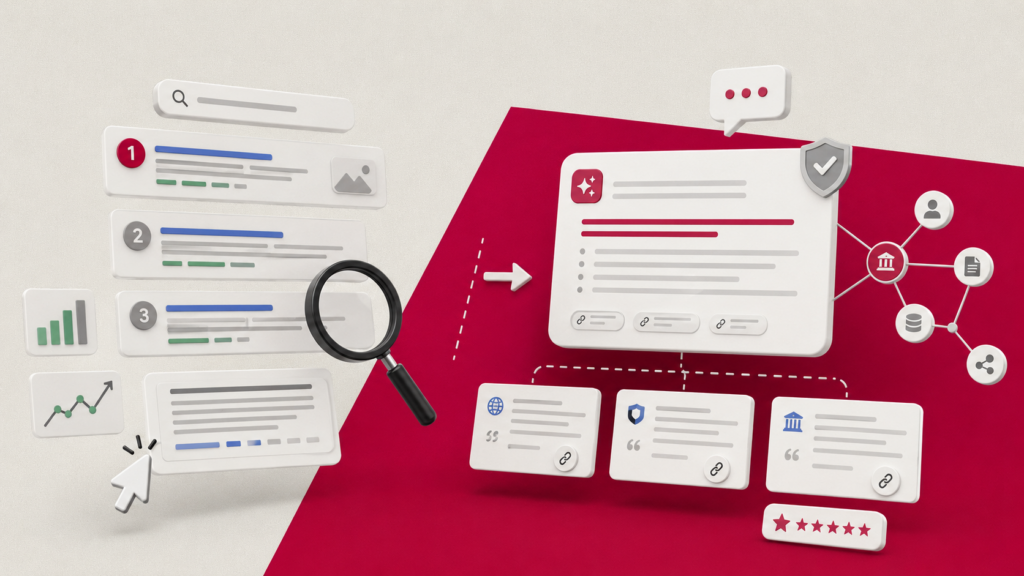
The Difference Between Traditional Search Visibility and AI Visibility
To diagnose AI visibility gaps correctly, you need to look at visibility through two lenses: how you appear in the SERP, and how you appear inside AI answers.
Traditional SEO Visibility
Traditional search visibility typically focuses on:
- Rankings
- Organic traffic
- Click-through rates
- Featured snippets
- SERP features
- Keyword positions
These metrics are still useful because they show how your website performs in search engines. But they mostly measure where your site appears as a clickable result.
AI Visibility
AI visibility focuses on:
- AI citations
- Conversational recommendations
- Entity recognition
- Knowledge graph associations
- AI summary inclusion
- Brand mention frequency
In traditional SEO, you are trying to win ranking positions. In AI visibility, you are trying to become a trusted source that AI tools confidently use when answering users.
That distinction is important.
A page can rank well and still be ignored by AI systems. Likewise, a brand can influence users through AI mentions even when users do not click through to the website.
Rankings tell you where you appear in search results. AI visibility tells you whether your brand is included in the answers users actually consume.
Why Traditional Metrics Alone Are Not Enough
AI-generated answers are reducing clicks in many search experiences. In some cases, users may get the answer they need without clicking through to any website.
A brand can influence users through AI mentions even if users never visit the website directly. Because of this, SEO professionals must begin measuring visibility beyond rankings and traffic alone.
Rankings tell you where you appear in search results. AI visibility tells you whether your brand is being included in the answers users actually consume.
How AI Search Engines and AI Assistants Retrieve Information
AI search systems typically generate answers by pulling from external sources (retrieval), interpreting entities and relationships, and selecting contextually relevant information.
Retrieval-Augmented Generation
Most modern AI systems use retrieval-based frameworks. Instead of relying only on pre-trained knowledge, AI tools retrieve information from external sources before generating responses.
This process typically involves:
- Query interpretation
- Source retrieval
- Content evaluation
- Context synthesis
- AI-generated response creation
The sources AI systems retrieve heavily influence visibility. This is why your content must be easy to crawl, easy to understand, and trustworthy. If an AI system cannot confidently retrieve and interpret your content, it may choose a competitor’s page instead.
Entity Understanding and Knowledge Graphs
AI systems rely heavily on entities. Entities are identifiable concepts such as:
- Brands
- People
- Products
- Companies
- Locations
- Topics
Strong entity associations improve the likelihood of being recognized and cited. For example, if your company is consistently associated with SEO, digital marketing, technical audits, and content strategy across trusted sources, AI systems have more context to understand your expertise.
Semantic Relevance and Context Matching
AI systems prioritize content that demonstrates:
- Topic depth
- Comprehensive coverage
- Clear contextual relationships
- High semantic relevance
- Strong intent matching
Keyword matching alone is no longer sufficient. You need to cover topics in a way that answers real questions, explains related concepts, and connects ideas clearly.
Common Sources Used by AI Systems
AI systems often retrieve data from:
- Authoritative websites
- Structured content
- Knowledge graphs
- Industry publications
- Forums and user-generated content
- News sites
- Reviews and citations
That is an important point. Your AI visibility depends not only on what you publish but also on how the rest of the web talks about your brand. External validation plays a huge role in how trusted and recognizable you become.
Common Causes of AI Visibility Gaps
AI visibility gaps usually come from a few predictable weaknesses—when your site lacks depth, clear entity signals, trust, technical accessibility, or scannable structure, AI systems tend to pull answers from competitors instead.
Weak Topical Authority
Websites with shallow content coverage often struggle to appear in AI-generated answers. AI systems prefer sources that demonstrate deep expertise across entire topic clusters.
If you want to improve topical authority, build supporting content around your main service pages and pillar articles. Cover definitions, comparisons, use cases, examples, common mistakes, tools, processes, and FAQs. This helps AI systems see that your website is a complete resource, not just a surface-level answer.
Poor Entity Recognition
If your brand lacks strong entity signals, AI systems may fail to understand:
- Who you are
- What you specialize in
- How you relate to certain topics
Inconsistent branding across the web can worsen this issue. I recommend checking your About page, author bios, organization schema, social profiles, and external citations. Your brand name, description, services, location, and expertise should be consistent across the web.
Low Trust Signals
AI systems prioritize trustworthy information. Weak trust signals may include:
- Poor author credibility
- Limited citations
- Few backlinks
- Lack of reviews
- Weak brand mentions
To strengthen trust, show real expertise. Add author credentials, cite reliable sources, publish case studies, collect reviews, earn mentions from reputable websites, and keep your content factually accurate. Trust is not built by saying you are an expert. It is built by proving it.
Technical SEO Problems
Technical issues can reduce retrievability and visibility. Common issues include:
- Crawlability problems
- Broken structured data
- Slow performance
- Weak internal linking
- Rendering issues
AI systems still depend on accessible information. If search engines and retrieval systems have trouble accessing your pages, your chances of appearing in AI-generated answers drop. A clean technical foundation is still one of the most important parts of SEO and AEO.
Poor Content Formatting
AI systems favor content that is:
- Easy to scan
- Structured logically
- Concise and direct
- Rich in summaries and definitions
Poor formatting can reduce AI readability. Use descriptive headings, short paragraphs, direct answers, tables when useful, and summaries where appropriate. I also recommend adding clear definitions near the top of informational content so AI systems can easily extract the main answer.
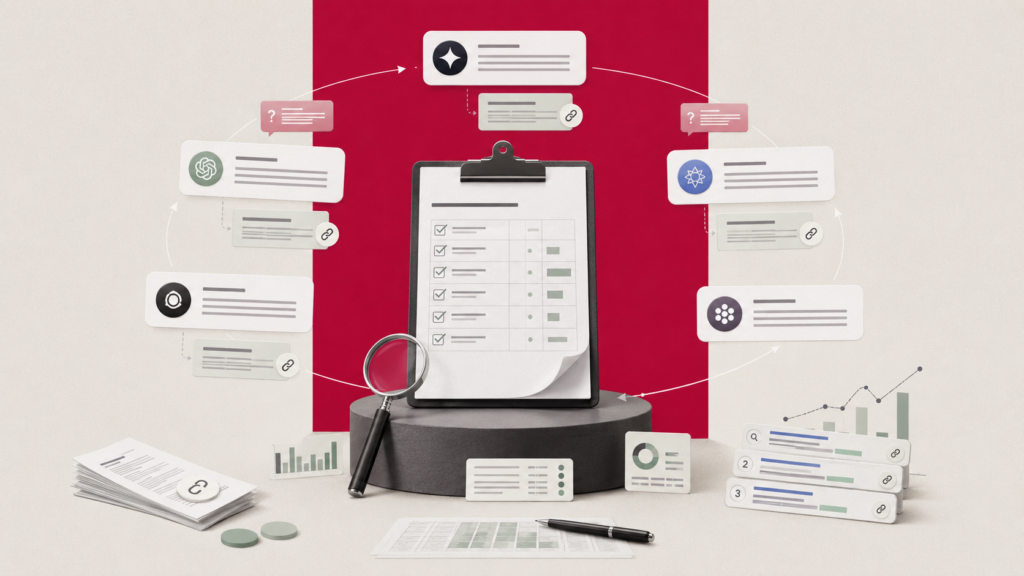
How to Manually Audit Your Current AI Visibility
To audit your current AI visibility, you’ll want a repeatable process for testing prompts across platforms, tracking mentions and citations, and then comparing those results against your normal SEO performance to spot gaps quickly.
Manual AI Visibility Testing
Start by testing prompts manually across platforms like:
- ChatGPT
- Gemini
- Claude
- Perplexity
- Google AI Overviews
Search for:
- Brand mentions
- Recommendations
- Comparisons
- Service-related prompts
- Informational questions
Do not test only your brand name. Test the real questions your customers would ask before choosing a provider. This gives you a practical view of how AI systems currently talk about your brand, competitors, and industry.
If you’re not sure what kinds of prompts your customers would be looking for, I have a guide on how to do prompt research you should read up on to get started.
Use Different Prompt Types
Test multiple prompt categories such as:
Branded Prompts
Example: “What is SEO Hacker known for?”
Branded prompts show whether AI systems understand your company clearly and accurately.
Non-Branded Prompts
Example: “Best SEO agencies in the Philippines”
Non-branded prompts reveal whether your brand appears when users are searching by need rather than by name.
Comparison Prompts
Example: “SEO Hacker vs other SEO agencies”
Comparison prompts show whether AI systems can compare your brand accurately against competitors.
Informational Prompts
Example: “How do SEO agencies improve rankings?”
Informational prompts reveal whether your content is being used to explain broader industry topics.
Track AI Citations
Document:
- Which competitors appear most often
- Which domains receive citations
- Which content formats dominate responses
Create a simple spreadsheet and track the prompt, tool used, date tested, brands mentioned, sources cited, and whether your website appeared. Over time, this gives you a baseline for measuring improvement.
Compare SERP Visibility vs AI Visibility
One of the biggest discoveries during audits is that high-ranking pages may have weak AI visibility.
Compare:
- Ranking keywords
- Organic traffic
- AI mentions
- AI citations
- Conversational query exposure
This comparison often reveals hidden visibility gaps. Your SEO performance and AI visibility do not always move together, so both need to be reviewed.
How to Use SEO/AEO/GEO Tools to Detect Visibility Gaps
If you want one place to connect classic SEO research with AI visibility signals, Semrush One is built for that. While Semrush was originally built for search visibility analysis, many of its newer features under its AI toolkit are extremely useful for uncovering the same weaknesses that affect AI visibility.
I usually start by identifying where competitors are consistently outranking or out-appearing my website across informational and conversational queries. From there, I analyze missing content coverage, weak authority signals, and unsupported topic clusters.
Keyword Gap Tool
The Keyword Gap tool is one of the fastest ways to discover missing visibility opportunities.
I use it to identify:
- Keywords competitors rank for that my site does not
- Informational queries competitors dominate
- Missing conversational search opportunities
- Weak supporting topic coverage
This is especially useful for uncovering content gaps that may affect AI retrieval. If competitors consistently rank for supporting subtopics while your site only targets broad commercial terms, AI systems may view their content as more comprehensive and trustworthy.
Topic Research Tool
The Topic Research tool helps uncover subtopics, questions, and related discussions users actively search for.
I use this when building:
- Supporting content clusters
- FAQ sections
- Conversational query content
- AI-friendly informational pages
A lot of AI visibility gaps happen because websites fail to answer enough related questions around a topic. This tool makes those gaps easier to spot.
Organic Research Tool
Organic Research helps me identify competitor pages that consistently earn visibility across large topic sets.
I usually analyze:
- Top-performing competitor URLs
- Traffic-driving informational pages
- Pages ranking for high-intent queries
- Content formats dominating the SERPs
When I notice competitors repeatedly ranking for educational or comparison-based content, it usually tells me they are building stronger topical authority signals that AI systems may also trust.
Backlink Analytics
AI systems still rely heavily on trust and authority signals. That is why I also review competitor backlink profiles.
Using Backlink Analytics, I look for:
- High-authority referring domains
- PR mentions
- Industry citations
- Trusted publications linking to competitors
- Content assets earning natural backlinks
This helps explain why certain competitors appear more often in AI-generated answers even when their content quality is similar.
Position Tracking
Position Tracking is useful for monitoring how visibility changes over time.
I personally track:
- Commercial keywords
- Informational queries
- AI-overview-triggering keywords
- Featured snippets
- Competitor movement
While it does not directly measure AI citations, it helps identify which topics and queries are gaining visibility and momentum.
Combining Semrush Data with AI Prompt Testing
One mistake I see people make is relying only on AI prompt testing without validating what is happening in actual search results.
I prefer combining:
- AI prompt testing
- Semrush competitor analysis
- Search Console performance data
- Content audits
- Entity optimization reviews
This gives me a more complete picture of why certain brands are repeatedly cited while others are ignored. For example, if competitors dominate informational queries, own stronger backlink profiles, and cover more related subtopics, it becomes easier to understand why AI systems may trust them more.

Key Metrics and Signals to Measure for AI Visibility
To measure AI visibility properly, track a mix of presence signals (mentions and citations), coverage signals (topic depth and entities), and trust signals (reputation and authority), then sanity-check impact using whatever AI-driven traffic you can observe.
AI Mention Frequency
Track how often AI tools mention your brand. Do not measure this once and stop. AI responses can change as tools update their retrieval systems, indexes, and models.
AI Citation Share
Measure the percentage of AI citations attributed to your website compared to competitors. A brand mention is valuable, but a citation is stronger because it means the AI system found your content useful enough to support the answer.
Topic Coverage Depth
Evaluate whether your website comprehensively covers important topics and subtopics. Thin topic coverage often leads to weak AI visibility because AI systems prefer sources with depth and context.
Entity Strength
Assess:
- Knowledge graph presence
- Brand consistency
- Author associations
- Semantic relationships
Entity strength is not only about your website. It also depends on external profiles, citations, social accounts, directories, and industry mentions.
Brand Sentiment and Reputation
AI systems may favor brands with:
- Positive reviews
- Strong reputation
- Industry recognition
- Trusted mentions
Audit your reviews, testimonials, case studies, awards, certifications, and third-party mentions. These signals help support the idea that your brand is not only relevant but also trustworthy.
AI Referral Traffic
Monitor traffic patterns that may originate from AI platforms where possible. Some AI tools already send referral traffic, while others may influence users without creating obvious attribution.
This is why I do not rely on AI referral traffic alone. It is useful, but incomplete. Pair it with prompt testing, citation tracking, and brand mention monitoring.
Competitor AI Visibility Gap Analysis
Competitor AI visibility gap analysis is about pinpointing which competitors consistently get mentioned or cited in AI answers, diagnosing the specific content/authority/entity signals behind that visibility, and turning those findings into clear benchmarks and priorities you can execute against.
Identify AI-Visible Competitors
Some competitors may dominate AI-generated answers even if they are not the highest-ranking websites.
Identify:
- Frequently cited brands
- Highly referenced domains
- Common AI-recommended websites
Do this across multiple prompt types. A competitor may not appear for broad informational prompts but may show up consistently for commercial or comparison-based prompts. That tells you where they are strongest.
Reverse Engineer Their Visibility
Competitor research tools can make this process more efficient by revealing:
- Top-performing competitor pages
- Shared and missing keywords
- Authority-building backlinks
- Content gaps
- High-performing topic clusters
Analyze:
- Content structure
- Topical coverage
- Schema implementation
- Backlink profiles
- PR presence
- Author credibility
When I reverse engineer AI-visible competitors, I am not looking to copy them. I am looking to understand why AI systems may trust or retrieve them more often.
Questions to Ask During Analysis
Ask practical questions during your competitor review:
- Which prompts trigger competitor mentions?
- What content formats are performing well?
- What trust signals do competitors possess?
- Which entities are strongly associated with them?
These questions help you move from observation to action. The goal is not just to know that competitors are winning. The goal is to understand what makes them more visible and where you can close the gap.
Build AI Visibility Benchmarks
Create comparison benchmarks for:
- AI mentions
- Citation frequency
- Entity authority
- Topic depth
- Structured content quality
This also helps with reporting. Instead of saying “we need better AI visibility,” you can show exactly which competitors appear more often, which prompts you are missing, and which content areas need improvement.
Content-Level AI Visibility Gaps
Competitor AI visibility gap analysis is about identifying which brands consistently show up in AI-generated answers, understanding why they’re being retrieved and cited, and turning those patterns into clear benchmarks and action items for your own strategy.
Missing Topics and Search Intents
Many AI visibility gaps originate from incomplete topic coverage.
Look for:
- Missing subtopics
- Weak content clusters
- Unaddressed user questions
- Incomplete informational coverage
Tools like topic research platforms and keyword gap tools can help identify:
- Underserved subtopics
- Missing informational queries
- Conversational keyword opportunities
- Competitor-covered topics your site lacks
If your website does not answer enough related questions, AI systems may choose a competitor with a more complete resource.
Weak Answer Optimization
AI systems favor direct and concise answers.
Improve:
- Definitions
- Summaries
- FAQs
- Lists
- Step-by-step explanations
I like to answer the main question clearly near the beginning of a section, then expand with context, examples, and practical tips. This makes the content more useful for users and easier for AI systems to extract.
Lack of Conversational Content
Modern AI search is conversational.
Content should address:
- Natural language queries
- Long-tail searches
- Follow-up questions
- Multi-intent searches
Think less like a keyword list and more like a conversation with a potential customer. Add sections that answer how, why, what, when, best, vs, and should questions.
Outdated Content
AI systems may prioritize fresher content for evolving topics. Regular updates improve visibility and trust.
Schedule regular content updates, especially for fast-moving topics like AI search, SEO tools, algorithm updates, legal topics, finance, healthcare, and software. Freshness alone will not save weak content, but outdated content can definitely hold you back.
Formatting Problems
Improve readability using:
- Clear headings
- Bullet points
- Tables
- Short paragraphs
- Summary sections
Bullets are great for scanning, but they should be supported by useful context. A list without explanation may feel thin, especially for complex SEO topics.
Technical SEO and Structured Data Gaps
Technical SEO and structured data gaps are the “retrievability” problems. When crawlers and AI systems can’t reliably access, interpret, and connect your pages (through schema, indexability, internal links, and performance), your content is far less likely to be used or cited in AI-generated answers.
Structured Data for AI Readability
Schema markup improves machine understanding.
Important schema types include:
- Organization schema
- Article schema
- FAQ schema
- Product schema
- Review schema
- Author schema
Schema will not magically guarantee AI citations, but it can make your content easier to interpret. Use structured data to clarify who published the content, what the page is about, who the author is, and how your business information should be understood.
Crawlability and Indexability
Ensure important pages are:
- Crawlable
- Indexable
- Properly linked
- Accessible to search engines
For a crawl-based technical audit (broken links, redirects, canonicals, robots directives, and sitemap checks), Screaming Frog’s SEO Spider toolkit is a practical way to surface issues and export them for fixes.
Internal Linking Gaps
Strong internal linking helps reinforce topical relationships and entity associations.
Link related articles together naturally. Connect pillar pages to supporting content. Use descriptive anchor text that reflects the topic being linked. Internal linking is one of the simplest ways to strengthen a topic cluster.
Page Experience Signals
Optimize:
- Core Web Vitals
- Mobile usability
- Accessibility
- Site speed
Poor user experience can indirectly weaken AI visibility. A fast, accessible, mobile-friendly website is not just good for rankings. It also makes your content easier to consume and more reliable as a source.
Entity and Knowledge Graph Gaps
Entity SEO focuses on helping search engines and AI systems understand:
- Who your brand is
- What topics you are associated with
- How you relate to other entities
This is especially important in AI search because AI systems do not just match keywords. They interpret relationships. They try to understand whether your brand is connected to a topic, location, service, expert, or industry.
Build a Strong Brand Entity
Strengthen your entity profile through:
- Consistent brand naming
- Detailed About pages
- Author bios
- Structured organization information
- Social and citation consistency
Your brand information should be clear and repeated consistently across trusted sources. If your website says one thing, your LinkedIn says another, and directories list outdated details, AI systems may have less confidence in your entity.
Improve Knowledge Graph Presence
Increase entity trust through:
- Wikidata references
- Industry directories
- Authoritative citations
- Media mentions
- Trusted external profiles
Do not chase every directory. Focus on sources that are credible in your industry. Quality matters more than quantity when building entity trust.
Map Entity Relationships
Connect related topics and supporting content strategically across your website.
For example, if you want to be associated with technical SEO, your site should also cover crawlability, indexation, Core Web Vitals, structured data, site architecture, and SEO audits. This helps AI systems understand your topical ecosystem.
Brand Mention and Citation Gaps
Brand mention and citation gaps happen when your site is strong but the wider web isn’t reinforcing it. If credible third-party sources don’t reference you consistently, AI systems have fewer signals to treat your brand as authoritative enough to cite or recommend.
Why External Validation Matters
AI systems often evaluate how other trusted websites reference your brand. This means off-page authority remains critical.
You can publish excellent content, but if no one credible references your brand, competitors with stronger external validation may still outperform you in AI-generated answers. External mentions help confirm that your brand is recognized outside your own website.
Build AI-Relevant Authority
Focus on:
- Digital PR
- Expert contributions
- Podcasts
- Interviews
- Guest content
- Industry mentions
These are not just branding activities. Off-Page SEO, when done well, will also strengthen the signals AI systems use to understand authority. My tip is to prioritize relevance. A mention from a trusted industry publication is usually more valuable than a random backlink from an unrelated site.
Increase Citation Opportunities
The more authoritative sources mention your brand, the stronger your AI visibility may become.
Create link-worthy assets like original research, case studies, data reports, expert guides, and opinion pieces. These types of content are more likely to earn natural references from other websites.
Conversational Query and Prompt Gaps
Conversational query and prompt gaps happen when your content is written for short keywords, but users are now asking AI tools full questions, comparisons, and decision-style prompts—so you need to identify the prompt patterns you’re missing and format content in a way AI can lift and recommend.
The Rise of Conversational Search
Users increasingly search using:
- Questions
- Comparisons
- Multi-step prompts
- Context-heavy requests
Instead of typing short keywords, they ask AI tools for recommendations, explanations, pros and cons, and decision support. This means your content should be built for real user conversations.
Identify Prompt Gaps
Common prompt gaps include missing optimization for:
- “Best” queries
- “How” questions
- Comparisons
- Decision-stage searches
- Local recommendations
For example, a traditional keyword might be “SEO agency Philippines.” A conversational prompt might be “Which SEO agency in the Philippines is best for a B2B company with a limited budget?” These are very different search behaviors, and your content should address both.
Create Prompt-Friendly Content
Optimize content with:
- Direct answers
- Concise summaries
- Comparison tables
- FAQs
- Clear explanations
I recommend adding practical sections like “Who this is best for,” “Common mistakes,” “How to choose,” and “What to look for.” These sections often match how users ask AI tools for help.
E-E-A-T and Trust Signal Gaps
E-E-A-T and trust signal gaps show up when your content is relevant, but it doesn’t feel verifiable. Without clear experience, credible authorship, and reputation signals, AI systems have less confidence to retrieve and cite you as a reliable source.
Why Trust Matters in AI Retrieval
AI systems prefer reliable and authoritative sources. Strong E-E-A-T signals improve the likelihood of being retrieved and cited.
E-E-A-T stands for experience, expertise, authoritativeness, and trustworthiness. For AI visibility, this matters because AI systems need confidence that your information is accurate, useful, and credible.
Strengthen E-E-A-T Signals
Improve:
- Author expertise
- First-hand experience
- Original research
- Case studies
- Expert insights
Do not just publish generic content that anyone could write. Add real examples, original observations, client lessons, data, screenshots, and expert commentary where appropriate.
Build Reputation Signals
Reputation signals include:
- Reviews
- Testimonials
- Awards
- Certifications
- Industry recognition
These signals help users trust you, but they also help reinforce your brand’s authority across the web. Make sure they are visible, accurate, and connected to the services or topics you want to be known for.
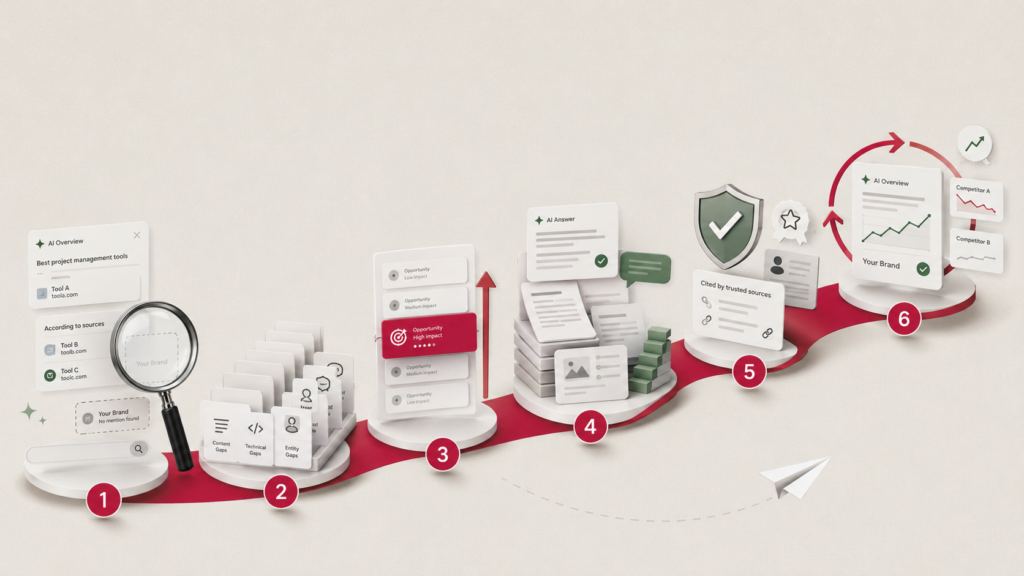
Workflow for Fixing AI Visibility Gaps
Once you’ve identified your gaps, the next step is having a repeatable workflow that turns those findings into prioritized fixes and measurable improvement.
Step 1: Identify Missing AI Mentions
Determine where competitors appear but your brand does not. Test commercial, informational, branded, non-branded, comparison, and local prompts.
Document the results carefully. You need a baseline before you can measure improvement.
Step 2: Categorize Visibility Gaps
Classify issues into:
- Content gaps
- Technical gaps
- Entity gaps
- Trust gaps
- Conversational gaps
For example, if your content is strong but your brand is not mentioned anywhere externally, the issue may be authority. If your brand is known but your pages are not crawlable, the issue may be technical.
Step 3: Prioritize High-Impact Opportunities
Focus first on:
- High-conversion topics
- High-volume prompts
- Competitive keywords
- Revenue-driving content
Not every gap deserves the same level of effort. I usually prioritize pages that can influence leads, sales, or strategic positioning.
Step 4: Improve Content Quality
Enhance:
- Semantic depth
- Answer formatting
- Readability
- Conversational optimization
This often means expanding thin sections, adding examples, improving structure, answering follow-up questions, and updating outdated information.
Step 5: Strengthen Authority Signals
Improve:
- Digital PR
- Citations
- Backlinks
- Author credibility
Authority is one of the hardest gaps to fix quickly, but it is also one of the most valuable. Work on earning trust from credible sources in your industry.
Step 6: Re-Test and Monitor
AI visibility optimization is ongoing.
Continue monitoring:
- Mentions
- Citations
- Rankings
- AI responses
- Competitor movements
Do not treat this as a one-time audit. AI tools, search engines, and user behavior are changing quickly. Regular testing helps you stay ahead of the curve.
Common Mistakes You Should Avoid While Working on Your AI Visibility
AI visibility optimization works best when you avoid a few predictable traps—especially the ones that look “SEO-correct” but don’t translate well to AI answers.
Focusing Only on Rankings
Traditional rankings alone no longer guarantee discoverability. You can rank well and still be absent from AI-generated answers.
Keep tracking rankings, but add AI mentions, citations, and prompt visibility to your reporting. That gives you a more realistic view of modern search performance.
Over-Optimizing for Keywords
AI systems prioritize semantic understanding over exact-match keyword repetition. If your content reads unnaturally because you are forcing keywords, you are making the user experience worse.
Focus on clear explanations, related concepts, natural language, and complete answers. Keywords still matter, but context matters more.
Publishing Thin AI-Generated Content
Low-quality, purely AI-generated content may weaken trust and authority. Publishing more content does not automatically mean better visibility.
Use AI as a support tool, but add human expertise, original insight, examples, and editorial review. That is what separates useful content from generic content.
Ignoring Entity Optimization
Weak entity signals reduce recognition in AI systems. If AI tools cannot clearly understand your brand, they are less likely to mention or recommend it.
Make your brand identity clear across your website and external profiles. Consistency is a simple but powerful entity SEO practice.
Neglecting Off-Page Authority
External trust signals remain highly influential. AI systems do not evaluate your website in isolation.
Earn mentions, backlinks, reviews, citations, and media coverage from credible sources. Your reputation across the web supports your visibility inside AI-generated answers.
Failing to Update Content
Freshness and accuracy continue to matter in AI retrieval. Outdated content can cause AI systems to skip your pages or summarize old information incorrectly.
Review important content regularly. Update statistics, screenshots, tool names, examples, internal links, and recommendations when needed.
Key Takeaway
Knowing how to find AI visibility gaps is becoming one of the most important challenges in modern SEO, AEO, and GEO. As users rely more on AI-generated answers, brands must optimize not only for rankings but also for how AI systems retrieve, synthesize, cite, and recommend information.
Finding AI visibility gaps requires evaluating:
- Topical authority
- Entity optimization
- Technical SEO
- Structured content
- Conversational relevance
- External trust signals
- Brand authority
My biggest advice is not to treat AI visibility as separate from SEO. Treat it as the next layer of SEO. The fundamentals still matter, but now they need to support a broader goal: showing up not just in results, but in answers.
The brands that succeed in AI-powered search will be those that become trusted, semantically relevant, and consistently cited or referenced across both search engines and AI assistants. For professionals, the goal is no longer just to rank. The goal is to become the source AI systems trust—and the brand their generated answers confidently lean on.
The post How to Find AI Visibility Gaps Before Your Competitors Do appeared first on SEO Services Agency in Manila, Philippines.


