



Competitor analysis used to be centered on one main question: who ranks above us in Google, and why?
That question still matters, but it is no longer enough. Your competitors may also be appearing inside ChatGPT answers, Perplexity citations, Gemini responses, Bing Copilot summaries, and Google AI Overviews. In many cases, users may see those competitor names, pages, directories, reviews, or reports before they ever reach a traditional search result.
This creates a new kind of visibility gap. And if you’re here wondering why your competitors are cited, or how to win these spots from them, then you’re already falling behind.
Knowing how to reverse engineer competitor citations on AI search helps you trace those AI-generated answers back to the prompts, cited pages, third-party sources, and trust signals behind them. By studying what gets cited and why, you can identify the content gaps, authority gaps, and visibility signals your brand needs to improve to compete in AI search results.
Quick Answer: How to Reverse Engineer Competitor Citations on AI Search
To reverse engineer competitor citations on AI search, start by testing the prompts your target audience would ask on platforms like ChatGPT, Perplexity, Gemini, Bing Copilot, and Google AI Overviews. Record which competitors appear, which URLs or third-party sources are cited, and what type of source is supporting the answer.
Then, analyze the cited pages to understand why they may have been used. Look at the page’s answer clarity, structure, topical depth, proof, freshness, entity signals, backlinks, and external validation. This helps you identify whether the gap is caused by content, authority, reputation, technical accessibility, or missing third-party mentions.
For a faster and more structured audit, use Semrush One. Its AI Visibility Toolkit can help you benchmark your brand against competitors, find prompts where competitors appear but you do not, review missing sources, and track priority prompts over time. Combine this with the tool’s Organic Research, Keyword Gap, and Backlink Analytics features to understand the SEO signals behind competitor citations.
Once you know why competitors are being cited, build stronger pages, improve entity signals, earn relevant third-party mentions, strengthen internal links, and retest the same prompts to measure progress.
Why is AI Using My Competitor as a Source?
That question matters a lot because AI-generated answers are becoming part of the search journey. When users ask tools like Google AI Overviews, ChatGPT, Perplexity, Gemini, or Bing Copilot for recommendations, explanations, comparisons, or buying advice, cited sources can shape what users trust.
A competitor citation in AI-generated search experiences does not always create an immediate click. But it can still influence awareness, authority, and brand recall.
That is why SEO professionals should not only ask: “Where do we rank?”
They should also ask: “Are we being cited by AI systems when users ask important questions?”
How AI Systems Choose Sources to Cite
AI systems choose sources through a query fan-out system, and evaluate information gathered by that system based on relevance, usefulness, and trust. The exact process varies by platform, but cited sources often share common traits that SEO professionals can analyze.
AI tools are more likely to cite sources that are:
- Relevant to the prompt
- Easy to retrieve
- Clear and well-structured
- Topically complete
- Factually useful
- Fresh enough for the query
- Supported by authority signals
- Connected to recognizable entities
- Accessible to crawlers
- Aligned with the search intent
This does not mean AI citations are perfectly predictable. They are not. Citations can change by platform, location, freshness, index access, and prompt wording.
But when you study citations across many prompts, patterns appear.
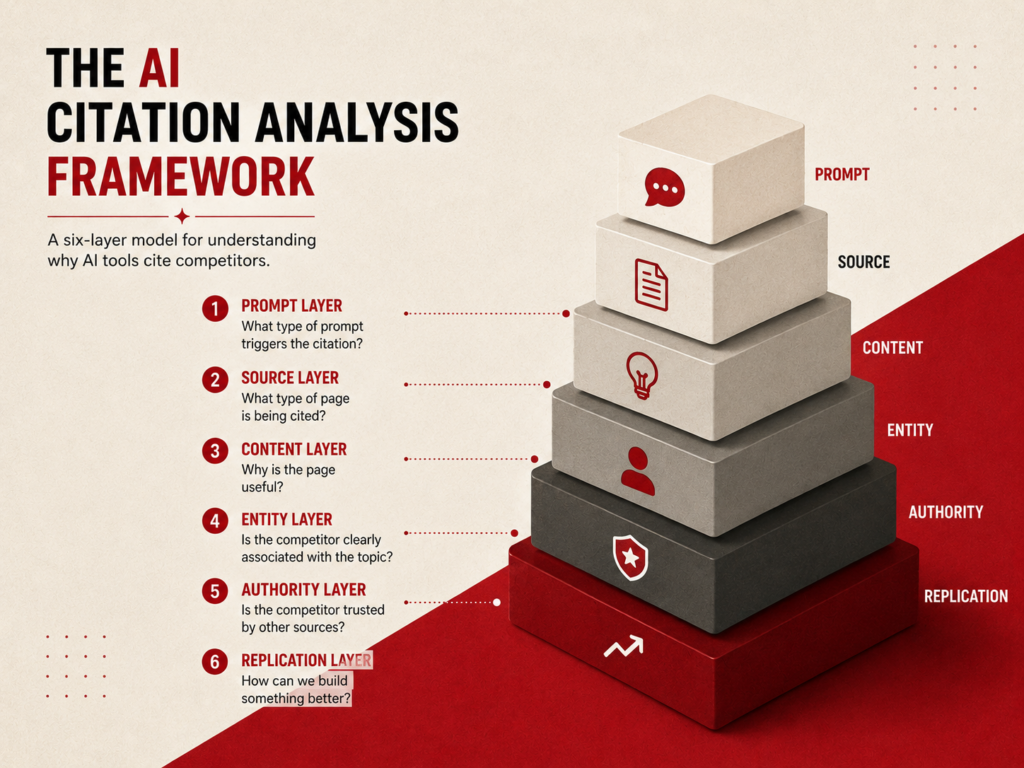
The AI Citation Analysis Framework
This framework helps you analyze how competitor brands are mentioned and cited on AI-generative search platforms. It breaks the process into six layers so you can identify whether the issue is related to the prompt, source type, content quality, entity clarity, authority, or your ability to build something better.
Layer Main Question What to Analyze Prompt Layer What type of page is being cited? Blog, guide, service page, report, directory, review page Source Layer What type of page is being cited? Blog, guide, service page, report, directory, review page Content Layer Why is the page useful Structure, definitions, examples, tables, FAQs, originality Entity Layer Is the competitor clearly associated with the topic? About page, author bios, schema, service pages, external profiles Authority Layer Is the competitor trusted by other sources? Backlinks, brand mentions, reviews, media mentions, directories Replication Layer How can we build something better? Content improvements, original data, stronger proof, authority building
Prompt Layer
The prompt layer identifies which queries trigger competitor citations. This is the starting point because the prompt tells you the exact user need the AI system is trying to satisfy.
Ask:
- What prompt produced the citation?
- Was it informational, commercial, comparison-based, local, or branded?
- Did the prompt include a specific audience, use case, industry, or location?
- Was the competitor cited for broad information or buying-stage advice?
Source Layer
The source layer identifies what type of source AI tools are citing. This helps you understand whether AI systems prefer educational content, commercial pages, third-party validation, or original research for a specific query.
Common source types include:
- Blog posts
- Service pages
- Comparison articles
- Research reports
- Case studies
- Glossary pages
- Review sites
- Industry directories
- News articles
- Forum discussions
- Third-party listicles
Content Layer
The content layer studies why the page is useful. This is where you evaluate whether the competitor’s content is clearer, deeper, fresher, or easier to extract than your own.
Review:
- Headings
- Definitions
- Answer blocks
- Tables
- FAQs
- Examples
- Step-by-step sections
- Original research
- Expert commentary
- Internal links
- External references
- Update dates
Entity Layer
The entity layer checks whether the competitor is clearly connected to the topic. If AI systems understand what a competitor is known for, they may be more confident citing that brand or its content.
Review:
- About page
- Author bios
- Organization schema
- SameAs links
- Service pages
- Brand descriptions
- Social profiles
- External profiles
- Third-party mentions
Authority Layer
The authority layer evaluates whether trusted sources validate the competitor. AI systems may treat externally validated brands and pages as more trustworthy sources.
Review:
- Backlinks
- Media mentions
- Industry citations
- Reviews
- Awards
- Partner mentions
- Podcast appearances
- Conference pages
- Guest articles
Replication Layer
The replication layer turns competitor insight into action. The goal is not to copy the competitor, but to create a better, more useful, more trustworthy source.
Use this layer to decide whether you need to update an existing page, build a new asset, improve entity signals, earn third-party mentions, or strengthen proof.
Before You Start the Citation Audit
Before you begin, prepare your audit inputs. AI citation analysis becomes messy if you test random prompts without a clear plan.
Prepare the following:
- Priority topics
- Priority services
- Target products or offers
- Target industries
- Target locations, if relevant
- Known SEO competitors
- AI-visible competitors
- Informational prompts
- Commercial prompts
- Comparison prompts
- Local prompts
- A citation tracking spreadsheet
- Access to AI tools
- Access to Semrush or another SEO, AEO, and GEO tool
- Access to Google Search Console
- Access to analytics data
You should also define what counts as a citation.
Track:
- Direct citations to competitor websites
- Citations to third-party pages mentioning competitors
- Citations to review platforms
- Citations to industry directories
- Citations to competitor research
- Citations to competitor case studies
- Citations to competitor landing pages
This makes your reporting more consistent.
Prompt Types to Test for Competitor Citations
Different prompt types reveal different citation patterns. A strong manual audit should include informational, commercial, comparison, problem-solving, local, and industry-specific prompts. This helps you see whether competitors are only visible for educational searches or if they also appear in high-intent queries that may influence leads, demos, consultations, or sales.
Informational Prompts
Informational prompts show which sources AI tools use when explaining a topic. These are useful for finding competitor blogs, guides, glossary pages, and educational content that AI platforms may consider reliable.
Examples:
- What is Answer Engine Optimization?
- How does AI search choose citations?
- How do businesses improve AI visibility?
- What are the best ways to optimize for AI Overviews?
- How do AI tools evaluate content quality?
Commercial Prompts
Commercial prompts show which brands appear when users are closer to choosing a provider, product, or service. These prompts are important because they can influence buying decisions.
Examples:
- Best AEO agencies for companies
- Top SEO agencies for AI search optimization
- Best AI visibility tools for marketing teams
- Recommended SEO agency for technical SEO audits
- Best content strategy agency for B2B companies
Comparison Prompts
Comparison prompts reveal which sources AI tools use to explain differences between brands, services, tools, or strategies. These prompts often surface comparison pages, review articles, listicles, and third-party guides.
Examples:
- AEO vs SEO
- GEO vs AEO
- Semrush vs Ahrefs for competitor research
- SEO Hacker vs other SEO agencies
- Best SEO tools for AI visibility tracking
Problem-Solving Prompts
Problem-solving prompts reveal citation opportunities tied to specific pain points. These prompts are useful because they often come from users who already know they have a problem and are looking for a practical solution.
Examples:
- Why is my website not appearing in AI Overviews?
- Why are competitors being cited by AI tools instead of my website?
- How do I get AI tools to cite my content?
- How do I improve brand mentions in AI search?
- How do I measure AI visibility?
Local Prompts
Local prompts reveal location-based citation gaps. These are especially useful for agencies, service providers, clinics, real estate companies, restaurants, and local businesses.
Examples:
- Best SEO agency in the Philippines
- Best digital marketing agency in Manila
- Recommended SEO consultant in Makati
- Top local SEO agency for Philippine businesses
- Best AEO agency in the Philippines
Industry-Specific Prompts
Industry-specific prompts show whether AI tools associate competitors with specific industries, verticals, or buyer segments. These are useful for finding niche visibility gaps.
Examples:
- Best SEO strategy for real estate developers
- How should healthcare clinics optimize for AI search?
- Best digital marketing strategy for law firms
- How can ecommerce websites improve AI visibility?
- Best SEO agency for B2B companies in the Philippines
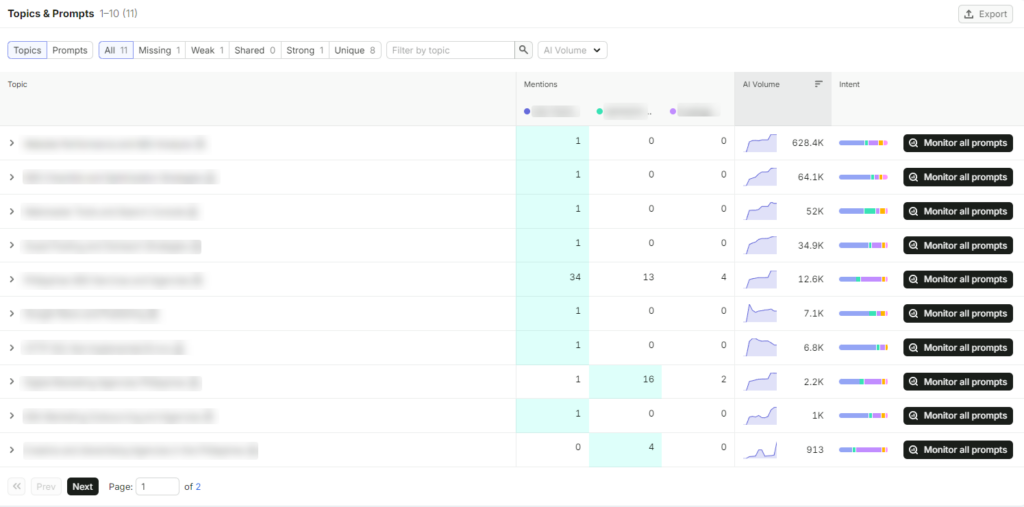
How to Use Semrush One to Reverse Engineer Competitor Citations
Semrush One can help explain why competitors are being cited by AI tools. It may not show every AI citation directly, but it can uncover the SEO signals behind cited competitor URLs. It also has a host of other features I use for SEO, AEO and GEO that I’ve covered in my Semrush One tool review.
Step 1: Benchmark Your AI Visibility Against Competitors
Start with the Competitor Research report inside the AI Visibility Toolkit. Enter your domain and add your main competitors so you can compare how often each brand appears in AI-generated answers.
Review:
- AI Visibility
- Audience
- Mentions
- Strong topics and prompts
- Weak topics and prompts
- Missing topics and prompts
- Competitor visibility trends
This helps you see where your brand is already visible, where competitors are outperforming you, and where your brand is completely missing from AI responses.
Step 2: Find Prompts Where Competitors Appear but You Do Not
Next, review the Topics & Prompts table. This is one of the most useful areas for reverse engineering AI search visibility because it shows the specific prompts and topic areas where competitors are being cited or mentioned while your brand is absent.
Look for:
- Missing prompts
- Weak prompts
- High-opportunity topics
- Commercial prompts
- Comparison prompts
- Informational questions
- Prompts with strong buyer intent
These gaps can reveal the questions your audience may already be asking AI platforms. They can also show which competitor pages, brand narratives, or third-party sources are shaping AI-generated answers in your niche.
Step 3: Review Missing Sources and Citation Opportunities
After reviewing prompts, switch to the Sources view. This shows external domains that AI platforms cite when brands are mentioned in AI responses. The Missing Sources filter is especially useful because it shows which sources are cited when competitors appear, but not when your brand appears.
Review:
- External domains cited for competitors
- Sources missing for your brand
- Industry publications
- Directories
- Review sites
- Comparison articles
- Partner pages
- Listicles
- Editorial mentions
This helps you identify where competitors are getting third-party validation. If AI tools consistently cite certain domains when recommending your competitors, those domains may become outreach, digital PR, partnership, or content placement opportunities.
Step 4: Use Prompt Research to Expand the Opportunity Set
Use Prompt Research to find additional AI search topics related to your product, service, or industry. This works like keyword research for AI search because it helps you discover the questions people are asking AI platforms and the brands or sources appearing in those responses.
Analyze:
- Related topics
- AI search volume
- Prompt intent
- Specific user questions
- Brands mentioned
- Source domains cited
- Commercial and transactional prompts
This helps you move beyond the prompts where you already know competitors are visible. You can uncover new question patterns, content angles, and source opportunities that may not appear in your manual testing.
Step 5: Send Priority Prompts to Prompt Tracking
Once you identify important prompts, add them to Prompt Tracking. This lets you monitor how your brand and competitors appear for those prompts over time.
Track:
- Your brand’s presence
- Competitor mentions
- Changes in AI visibility
- Newly appearing sources
- Lost visibility
- Prompt-level movement after optimization
This is important because AI visibility can change. Tracking prompts allows you to measure whether your content updates, outreach, and optimization efforts are improving your visibility in AI-generated answers.
Step 6: Use SEO Tools to Understand Why Competitors Are Being Cited
After identifying competitor prompts and sources, use Semrush’s traditional SEO tools to understand the signals behind those wins. AI visibility is not only about having the right answer on your website. It can also be influenced by search visibility, authority, topical depth, and external validation.
Use Organic Research to review:
- Competitor ranking pages
- Organic keywords
- Traffic-driving queries
- SERP features
- Ranking distribution
- Competing URLs
Use Keyword Gap to review:
- Topics competitors cover that you do not
- Missing informational keywords
- Comparison queries
- Long-tail questions
- Commercial keywords
- Prompt-like search queries
Use Backlink Analytics to review:
- Referring domains
- Authority of linking websites
- Anchor text
- Relevant industry links
- PR mentions
- Linkable assets
- Competitor authority gaps
This helps you separate content gaps from authority gaps. If competitors are appearing in AI answers because they are cited by trusted third-party websites, simply rewriting your own page may not be enough. If they are winning because their content is more complete, then the solution may be content expansion, better formatting, stronger FAQs, or clearer topical coverage.
Step 7: Turn the Findings Into an AEO & GEO Action Plan
Once you compare AI visibility data with SEO data, group the findings into clear action items.
Prioritize:
- Pages that need stronger answer sections
- FAQs that match missing prompts
- Comparison content
- Topic clusters around high-opportunity prompts
- Internal links to important pages
- Schema and technical improvements
- Outreach to missing source domains
- Digital PR for third-party validation
- Content updates based on cited competitor pages
The goal is not just to copy what competitors are doing. The goal is to understand why AI platforms trust, mention, or cite them, then build a stronger visibility strategy across your own website and the external sources AI tools rely on.
Semrush One makes this process easier because it connects AI visibility data with traditional SEO research. You can find where competitors are winning in AI search, identify the sources and prompts behind those wins, and use SEO data to decide whether the next step should be content optimization, authority building, technical improvements, or external citation development.
How to Manually Audit Competitor Citations on AI Search Platforms
To manually audit competitor citations on AI search platforms, you need to test realistic audience prompts, document which competitors appear, and identify the sources AI tools use to support those answers. This process helps you understand where competitors are gaining visibility in AI search and what signals may be helping them get mentioned or cited.
Step 1: Build a List of Prompts to Test
Start by creating a prompt list based on your services, products, target locations, industries, and buyer questions. These prompts should reflect what your audience may actually ask AI tools when researching a topic, comparing options, or looking for a provider.
Include different prompt types, such as:
- Informational prompts
- Commercial prompts
- Comparison prompts
- Local prompts
- Problem-solving prompts
- Industry-specific prompts
This gives you a broader view of competitor visibility across different stages of the search journey.
Step 2: Test the Prompts Across AI Search Platforms
Run each prompt across multiple AI search platforms. Do not rely on one tool because AI results can vary depending on the platform, search access, citation behavior, and generated response.
Use platforms such as:
- ChatGPT with search
- Google AI Overviews
- Perplexity
- Gemini
- Bing Copilot
- Other AI research tools with live search or citation features
For each platform, check whether the AI answer mentions a competitor, links to a competitor’s website, or cites a third-party source that talks about the competitor.
Step 3: Record Competitor Mentions and Citations
For every test, document both mentions and citations. Some AI tools provide clickable source links, while others only mention brands in the answer. Both are important because even an uncited brand mention can influence visibility, trust, and buying decisions.
For each test, record:
- Prompt tested
- AI platform used
- Date tested
- Competitor mentioned
- Competitor cited
- Cited URL
- Citation source type
- Whether your brand was mentioned
- Whether your website was cited
- Position or prominence of the competitor mention
- Context of the mention
- Sentiment of the mention
- Reason the source may have been used
- Recommended action
This helps you organize your findings and compare your brand’s AI visibility against your competitors.
Step 4: Save Evidence for Future Comparison
Save screenshots or copied responses, especially for high-value prompts. AI-generated answers can change over time, so keeping documentation helps you compare visibility before and after content updates, digital PR efforts, review improvements, or other AEO and GEO initiatives.
This also makes your audit easier to validate because you can revisit the exact prompt, platform, and response that produced the competitor citation.
Step 5: Classify the Citation Source Type
Once you identify cited sources, classify where each citation came from. This helps you understand what type of signal the AI platform may be relying on.
Citation source types may include:
- Competitor service page
- Competitor blog post
- Third-party listicle
- Review platform
- Industry directory
- News article
- Research report
- Forum or Reddit thread
This step is important because different citation types require different responses.
Step 6: Identify the Type of Gap
After classifying the sources, determine what kind of gap the citation reveals.
For example, if a competitor is cited through its own blog, the issue may be a content gap. If the competitor appears through a third-party listicle, the issue may be an authority or digital PR gap. If the competitor is recommended through review platforms, the issue may be a reputation gap. If the competitor appears through directories, the issue may be a source coverage gap.
Common gap types include:
- Content gap
- Authority gap
- Reputation gap
- Source coverage gap
- Local visibility gap
- Comparison content gap
- Proof or trust signal gap
Step 7: Look for Recurring Patterns
Do not base conclusions on one prompt or one AI platform. Test multiple prompt variations across multiple platforms, then look for recurring patterns.
Pay attention to:
- Competitors that appear repeatedly
- Sources that are cited repeatedly
- Topics where your brand is missing
- Prompt types where competitors are stronger
- Platforms where your brand has weak visibility
- Source types that AI tools seem to rely on most
The strongest opportunities usually appear when the same competitor, source, or citation pattern shows up more than once.
Step 8: Turn the Findings Into Action Items
Finally, translate your findings into specific actions. The goal is not just to list competitors being cited. The goal is to understand why they are appearing and what your brand needs to improve.
Your recommended actions may include:
- Creating or improving content around missing prompts
- Adding clearer answer sections and FAQs
- Building comparison pages
- Strengthening service pages
- Improving reviews and testimonials
- Earning mentions in relevant third-party listicles
- Building profiles in credible directories
- Creating original research or data-driven content
- Improving internal links to important pages
- Strengthening brand and author entity signals
The purpose of a manual competitor citation audit is to answer three questions: which competitors are being surfaced by AI tools, which sources are helping them appear, and what your brand needs to improve to compete for those mentions and citations.
Competitor Citation Audit Table
Use a table to document competitor citation findings. This turns the audit into a clear action plan instead of a loose list of observations.
Here’s an example that you can follow when making one from your own competitor audit:
Prompt Competitor Cited Cited URL Type Why It May Have Been Cited Gap Type Recommended Action How do I measure AI visibility? Competitor A Blog guide Clear metrics table and updated examples Content gap Build a stronger AI visibility measurement guide Best SEO agency in the Philippines for B2B companies Competitor B Third-party listicle Strong external validation from a relevant source Authority gap Earn mentions in B2B, marketing, and agency directories AEO vs SEO Competitor C Comparison article Direct answer, clear definitions, and comparison table Citation gap Create a stronger AEO vs SEO comparison page Why are competitors cited in AI answers? Competitor A Blog post Directly answers the prompt with practical steps Prompt gap Add prompt-specific sections to your guide Best technical SEO agency for ecommerce Competitor D Service page Ecommerce proof, service relevance, and case studies Conversion gap Build an ecommerce technical SEO landing page and supporting case study
Citation Source Types to Keep Track Of
Not all AI citations mean the same thing. A competitor’s own website being cited is different from a third-party article recommending that competitor. You need to classify each source properly so you know what action to take.
Source Type What It Means What to Do Blog post AI tools may trust the competitor’s educational content Improve your content depth, structure, examples, and answer clarity Service page AI tools may see the competitor’s offer as relevant to the prompt Improve service page clarity, proof, FAQs, and conversion messaging Research report AI tools may value original data or benchmark insights Create original research, surveys, studies, or industry reports Third-party listicle AI tools may rely on external validation Earn mentions in relevant listicles, directories, and review articles Review platform AI tools may consider reputation signals Improve reviews, testimonials, customer proof, and profile completeness Industry directory AI tools may use category-based references Build accurate profiles in credible industry directories News article AI tools may value media authority Strengthen digital PR, expert commentary, and thought leadership Forum or Reddit thread AI tools may use community sentiment Monitor discussions, improve brand reputation, and address recurring concerns
This source taxonomy helps you choose the right response. If AI tools cite competitor blogs, improve your content. If they cite third-party lists, build external validation. If they cite review platforms, improve reputation signals. If they cite research reports, create stronger original data.
How to Analyze Cited Competitor Pages
After you identify cited competitor pages, study why they may have been selected. The goal is not to copy the competitor’s page. The goal is to understand what makes it useful, trustworthy, and easy for AI tools to reference.
Review the Page Intent
Start by identifying the intent of the cited page. Your competing page should satisfy the same intent more completely if you want to compete for the same citation opportunity.
Check if the page is:
- Informational
- Commercial
- Transactional
- Comparison-based
- Local
- Research-based
- Educational
A competitor blog post, service page, directory listing, and review article all serve different purposes. Your response should match the type of gap you are trying to close.
Analyze the Page Structure
Next, review how the page is structured. AI tools are more likely to extract information from pages that are clear, organized, and easy to summarize.
Review:
- Title tag
- H1
- H2s and H3s
- Opening paragraph
- Definitions
- Tables
- Lists
- FAQs
- Summary sections
- Internal links
- External links
- Schema markup
Strong structure does not guarantee AI citations, but it makes the page easier to understand and reuse in AI-generated answers.
Analyze the Opening Answer
Check whether the competitor answers the main question quickly. A direct opening can make the content easier for both users and AI systems to understand.
A strong opening usually:
- Defines the topic clearly
- Answers the prompt directly
- Mentions the main entity
- Sets context early
- Avoids unnecessary introduction
- Uses simple language
If your page takes too long to answer the main question, your competitor may have an advantage even if your content is longer.
Analyze Topic Depth
Review whether the cited page covers related subtopics. Strong topical coverage helps AI tools understand that the page is a complete source on the subject.
For example, a strong article about competitor citations may cover:
- What AI citations are
- Why competitor citations matter
- How AI tools choose sources
- How to track cited pages
- How to analyze competitor content
- How to evaluate authority signals
- How to close citation gaps
- How to measure progress
If competitor pages answer more related questions than yours, the issue may be a content depth gap rather than only an authority gap.
Analyze Proof and Trust Signals
Look for proof elements that make the cited page more trustworthy. Proof is often what separates generic content from a page worth referencing.
Look for:
- Original data
- Case studies
- Examples
- Screenshots
- Quotes
- Statistics
- Methodology
- Expert commentary
- Client results
- Research references
If competitors include more proof than your page, your content may need stronger examples, original insights, or external validation.
How to Use AI Tools to Analyze Citation Patterns
AI tools can help analyze competitor citation patterns, but they should not replace SEO judgment. Use AI outputs as a research assistant, then validate the findings with manual review and SEO data.
Use AI to Summarize Cited Pages
AI tools can quickly summarize the structure and strengths of cited competitor pages. This can help you identify patterns before doing a deeper manual review.
Prompts to use:
- Summarize the structure of this competitor page.
- What makes this page useful for AI citation?
- What questions does this page answer well?
- What sections are missing from my competing page?
- What proof does this page include?
- What entities are strongly associated with this page?
Use AI to Generate Prompt Variations
AI tools can help expand your prompt testing set. This is useful when you want to test how different users might phrase the same need.
Ask:
- What prompts a company before choosing an AEO tool?
- What questions would a business owner ask about AI visibility?
- What comparison prompts might trigger AI citations for SEO agencies?
- What long-tail prompts are related to competitor citation analysis?
Use AI to Classify Citation Gaps
AI tools can help classify citation gaps, but the final decision should come from SEO judgment. Treat classification prompts as a way to speed up analysis, not as a replacement for expertise.
Example prompt:
“Classify the following citation gaps as retrieval, content, citation, entity, authority, prompt, accuracy, or conversion gaps. Explain the likely cause and recommended fix.”
Use AI output as a starting point, not the final diagnosis.
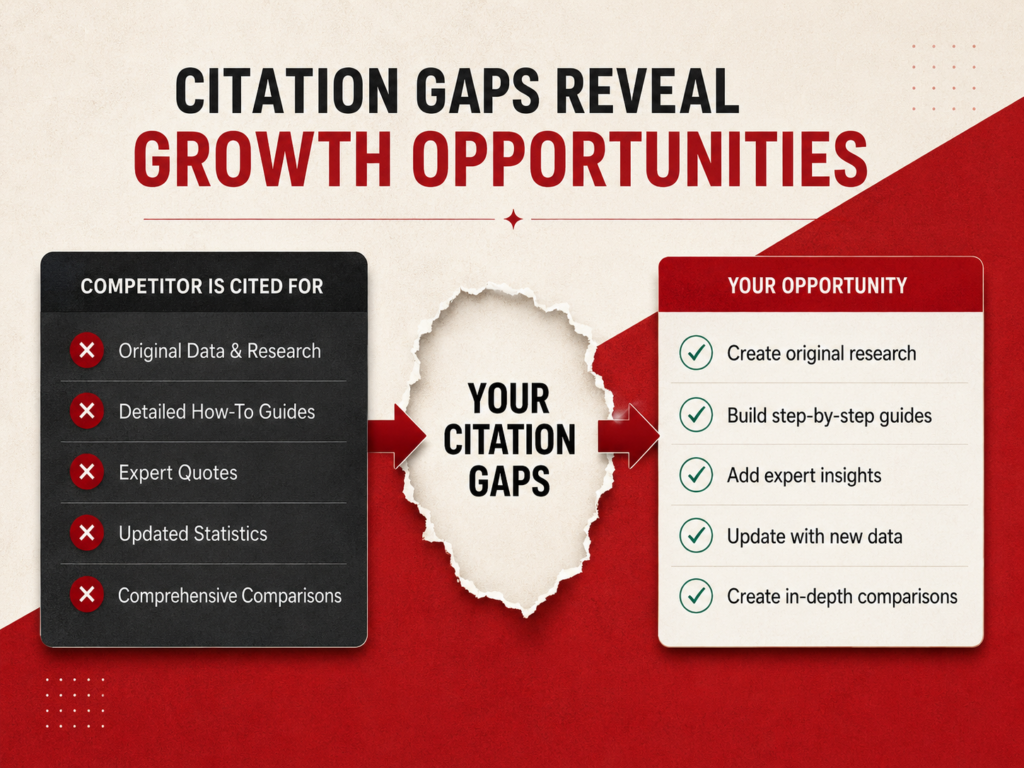
Citation Gap Types and Recommended Fixes
Citation gaps happen for different reasons, so each gap needs a different fix. Use this table to diagnose the likely cause before deciding what action to take.
Citation Gap Type What It Means Common Signs Recommended Fix Retrieval gap AI systems are not finding your content. Your page is not cited or mentioned. Fix crawlability, indexability, internal links, sitemaps, and accessibility. Content gap Competitor content answers the query better. The competitor has clearer definitions, examples, FAQs, or tables. Improve answer blocks, topic depth, examples, summaries, and structure. Citation gap AI finds the topic but cites competitors. Competitor URLs appear repeatedly. Add original data, expert input, stronger explanations, and citable assets. Entity gap AI does not associate your brand with the topic. Brand missing from relevant prompts. Improve About page, schema, sameAs links, author bios, and service pages. Authority gap Competitors have stronger trust signals. Competitors have more backlinks, PR, or reviews. Build digital PR, backlinks, case studies, testimonials, and industry mentions. Prompt gap Your content does not match conversational prompts. Competitors cited for long-tail or decision-stage queries. Add FAQs, comparison content, use-case sections, and natural language headings. Accuracy gap AI has outdated or wrong information. AI misstates your services, location, or expertise. Update website facts, schema, directories, and external profiles. Conversion gap Competitors are cited for buying-stage prompts. Your brand appears only for informational queries. Build comparison pages, pricing guides, case studies, and industry landing pages.
What to Do After the Citation Audit
After the audit, turn findings into an action plan. The goal is to move from observation to execution so your team knows which pages, signals, and assets to improve.
Step 1: Group Competitor Citations by Prompt Type
Grouping citations by prompt type helps reveal where competitors are strongest. It also shows whether your gaps are mostly informational, commercial, comparison-based, local, or industry-specific.
Separate citations into:
- Informational
- Commercial
- Comparison
- Local
- Industry-specific
- Problem-solving
Step 2: Group Gaps by Fix Type
Grouping gaps by fix type helps assign the right work to the right team. Some gaps require content updates, while others require technical fixes, PR, or reputation work.
Classify each gap as:
- Content improvement
- New page creation
- Technical SEO fix
- Schema improvement
- Entity optimization
- Digital PR opportunity
- Review or reputation improvement
- Internal linking update
Step 3: Build Better Content Assets
Better content assets should answer the prompt more clearly than competitor sources. They should also include proof, structure, and originality that make them more citation-worthy.
Create or improve pages with:
- Direct answers
- Clear definitions
- Original frameworks
- Comparison tables
- FAQs
- Examples
- Case studies
- Expert commentary
- Internal links
- Schema markup
Step 4: Strengthen External Validation
External validation helps AI systems and users see that your brand is trusted beyond your own website. This is especially important when competitors are cited through third-party sources.
Build authority through:
- Digital PR
- Guest articles
- Expert quotes
- Industry directories
- Partner mentions
- Research reports
- Case studies
- Podcast appearances
- Review platforms
Step 5: Retest AI Citations
Retesting helps you measure whether your improvements are changing AI visibility over time. Since AI citations can vary, look for patterns instead of one-time results.
Track whether:
- Your website earns more citations
- Competitor citation share decreases
- Your brand appears in more answers
- Your cited URLs improve
- AI descriptions become more accurate
- Commercial prompt visibility improves
Key Takeaway
Knowing how to reverse engineer competitor citations in AI search results is one of the most practical ways to improve AEO and GEO performance. When AI tools cite your competitors, they are showing you which sources they trust, which prompts they respond to, and what signals help those brands appear in AI-generated answers.
Those citations reveal where your gaps are, whether in content structure, topical depth, authority, entity clarity, source quality, or third-party validation. The goal is not to copy your competitors. It is to understand why they are being cited, then build something clearer, stronger, and more trustworthy.
Study the prompts. Analyze the cited URLs. Identify the source types. Strengthen your content, authority, and entity signals. Then retest over time.
AI citations are more than links inside AI answers. They are trust signals. The brands that win in AI search will be the ones that create the most useful, verifiable, and citation-worthy sources in their market.
The post How to Reverse Engineer Competitor Citations in AI Search appeared first on SEO Services Agency in Manila, Philippines.


