


I’ve used a lot of SEO tools over the years. Some are good. Some are bloated. Some look impressive until you actually try to use them for real client work.
Semrush has always been one of the more practical tools we’ve kept in our stack because it covers the core things SEO teams need: keyword data, rankings, site audits, competitor research, backlinks, and reporting.
But today, the question is no longer just, “Are we ranking?” It’s now: “Are we visible where buyers are making decisions?”
That still includes Google, of course. But it now also includes ChatGPT, Gemini, Claude, and Google AI Overviews.
Semrush One is built around that new question. And I’ve been testing it over the past month to see whether it is actually worth the upgrade. In this review, I’ll walk you through what it does well, where it falls short, and whether I think it is worth paying for if you care about your website’s visibility.
Quick Verdict: Is Semrush One Worth It?
Yes, Semrush One is worth it if you need to measure visibility across both traditional Google search and AI-generated answers. It is not the cheapest SEO platform, but it is one of the more practical and feature-heavy options I’ve seen for teams that want SEO and AI visibility reporting in one place.
Classic SEO tools answer questions like:
- What keywords do I rank for?
- How much organic traffic can I capture?
- Which competitors are outranking me?
- What technical SEO issues are holding my site back?
Semrush One adds a newer and increasingly important layer:
- Is my brand being mentioned in AI-generated answers?
- Is my website being cited as a source?
- Which prompts trigger my brand?
- Which competitors are being recommended instead of me?
- How do AI tools describe my brand?
- Am I visible in Google AI Overviews, ChatGPT Search, Gemini, Perplexity, and other AI-driven discovery surfaces?
That is why I see Semrush One less as a “new Semrush plan” and more as a repositioning of Semrush for the AI search era.
What I like most about Semrush One is that it does not treat AI visibility as a separate, disconnected experiment. It combines the familiar Semrush SEO Toolkit with the AI Visibility Toolkit, so I can evaluate rankings, technical SEO, competitors, prompts, AI mentions, AI citations, share of voice, and brand sentiment from the same ecosystem.
Semrush’s own documentation positions Semrush One exactly this way: a subscription that includes the core SEO Toolkit plus the AI Visibility Toolkit for search rankings, content performance, and AI-driven brand visibility.
My final verdict: Semrush One is best for serious SEO teams, agencies, SaaS companies, ecommerce brands, publishers, and in-house marketers who are already asking, “Are we showing up in ChatGPT, Gemini, Perplexity, or Google AI Overviews?”
The caveat: This LLM visibility tool may be overkill for a small blog, a very early-stage site, or a business that only needs basic keyword research.
What’s Included in the Semrush One Toolkit
Semrush One includes two major toolsets in one subscription: the traditional Semrush SEO Toolkit and the newer AI Visibility Toolkit. The SEO Toolkit helps me understand how my website performs in traditional search, while the AI Visibility Toolkit helps me understand how my brand appears in AI-generated answers.
This is the main reason Semrush One feels different from a standard SEO subscription. It gives me a way to connect keyword rankings, technical SEO, backlinks, AI mentions, AI citations, prompts, sentiment, share of voice (SOV), and competitor visibility in one workflow.
Semrush One Feature What It Helps Me Do Keyword research Find search demand, keyword difficulty, CPC, SERP features, and content opportunities for your industry Competitor analysis See what your competitors rank for, and where they are gaining search visibility Site audit An AI SEO audit that identifies both SEO and AI crawlability issues, and translates that into actionable fixes Rank tracking Monitor keyword positions in traditional search Backlink analysis Review referring domains, backlinks, link gaps, and outreach opportunities AI Visibility Overview See how a brand appears in AI-generated answers AI mentions and citations Track whether AI platforms mention or cite your brand or content Prompt research Discover AI-style questions and topics people ask Prompt tracking Monitor selected prompts daily Brand Performance Analyze AI sentiment, share of voice, and narrative drivers AI competitor research Compare your brand’s AI visibility against competitors
Semrush’s AI Visibility Toolkit is designed to benchmark brand AI visibility, analyze sentiment, discover relevant prompts, track daily prompt visibility, audit technical AI crawl blockers, identify competitive gaps, and turn AI visibility data into reports.
That matters because SEO is no longer just about ranking blue links. AI-generated answers now influence discovery, comparison, and purchase decisions. But I would not abandon SEO for AEO or GEO. That would be a mistake. SEO is still the base layer. AEO and GEO sit on top of it.
Think of it this way: SEO is keyword-centric. AEO and GEO are question-centric. SEO asks, “What keyword do we rank for?” AEO and GEO ask, “When a buyer asks a decision-stage question, does AI mention us, cite us, and describe us correctly?”
That is where Semrush One becomes useful.
Semrush One vs Semrush SEO Toolkit
The biggest difference is simple: The Semrush SEO Toolkit focuses on traditional SEO. Semrush One includes traditional SEO plus AI Visibility.
Semrush’s own plan comparison explains that Semrush One tiers inherit the features and limits of the corresponding SEO Toolkit tiers, then add AI Visibility tools and reporting.
| Plan Track | Main Purpose | Best For |
|---|---|---|
| Semrush SEO Toolkit | Traditional SEO workflows: keyword rankings, audits, backlinks, competitor analysis, and reporting | Teams focused only on Google SEO |
| Semrush One | Traditional SEO workflows plus AI visibility, AI citations, AI mentions, prompt research, prompt tracking, and AI brand performance | Teams responsible for total search visibility across Google and AI platforms |
That means I do not lose the classic Semrush SEO features when I choose Semrush One. I get the corresponding SEO Toolkit plan plus AI visibility features layered on top.
The tier mapping for Semrush One is also straightforward:
| Semrush One Plan | Includes SEO Toolkit Equivalent |
|---|---|
| Semrush One Starter | SEO Pro Toolkit |
| Semrush One Pro+ | SEO Guru Toolkit |
| Semrush One Advanced | SEO Business Toolkit |
That is important because AI visibility does not operate in isolation. Semrush explains that AI-generated answers are influenced by authority, content depth, structured information, and overall search presence. In other words, many of the things that help SEO also influence how AI systems understand and surface a brand.
My take: Semrush SEO Toolkit is enough if your only job is Google rankings. Semrush One is the better fit if leadership or clients are already asking about AI search visibility.
How Does Semrush One Work?
Semrush One works by combining traditional SEO monitoring with AI visibility analysis.
In a classic SEO workflow, I might ask:
“Where do we rank for this keyword?”
With Semrush One, I can add better questions to my workflow:
“Are we mentioned when someone asks AI about this topic?”
“Are competitors being cited instead of us?”
“What prompts trigger our brand?”
“Does AI describe our brand accurately?”
“Do we have pages that AI systems can crawl, understand, and cite?”
This is the shift from keyword-only SEO to question-led visibility.
In practice, I would use Semrush One like this:
- Set up my domain and competitors. I start by tracking my website and the competitors I care about.
- Review SEO performance. I check rankings, keywords, backlinks, site health, and competitor gaps.
- Review AI Visibility Overview. I look at AI mentions, AI citations, share of voice, and where competitors are appearing.
- Research prompts. I identify the natural-language questions buyers are likely asking AI tools.
- Track priority prompts. I monitor important prompts over time, especially bottom-funnel questions like “best,” “top,” “recommended,” “alternative,” and “comparison” queries.
- Fix content and technical blockers. I use the SEO and AI audit insights to improve crawlability, structure, content depth, and answer quality.
The value is not just “seeing data.” The value is seeing where SEO, content, brand perception, and AI answers intersect.
Semrush One Key Features
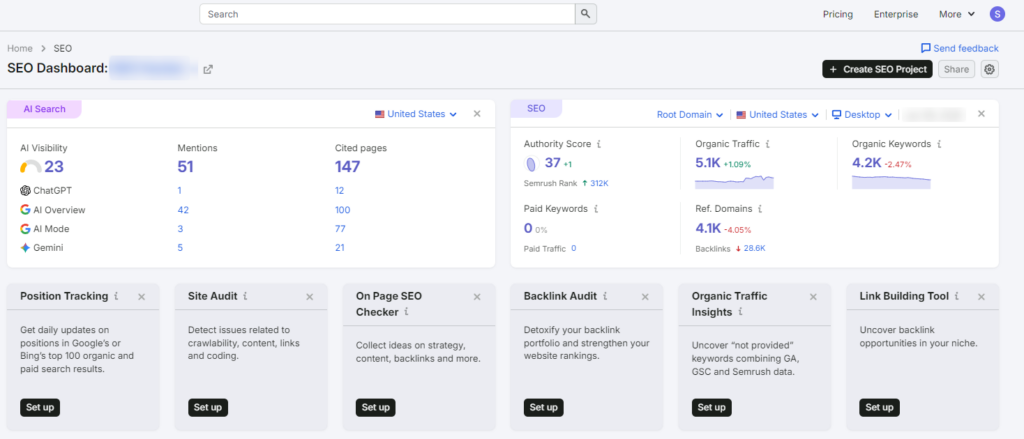
1. Unified SEO and AI Visibility Dashboard
The strongest feature of Semrush One is the unified SEO and AI visibility dashboard. I can see traditional search performance and AI search visibility in one ecosystem instead of jumping across separate tools.
This is especially useful for reporting. A modern visibility report should not only show rankings, traffic, and backlinks; it should also show AI mentions, citations, prompt performance, sentiment, and share of voice.
That makes the conversation more complete. If I am advising a business, I do not want to only say, “You rank here.” I also want to say, “Here is how Google sees you, here is how AI talks about you, and here is where competitors are being surfaced instead.”
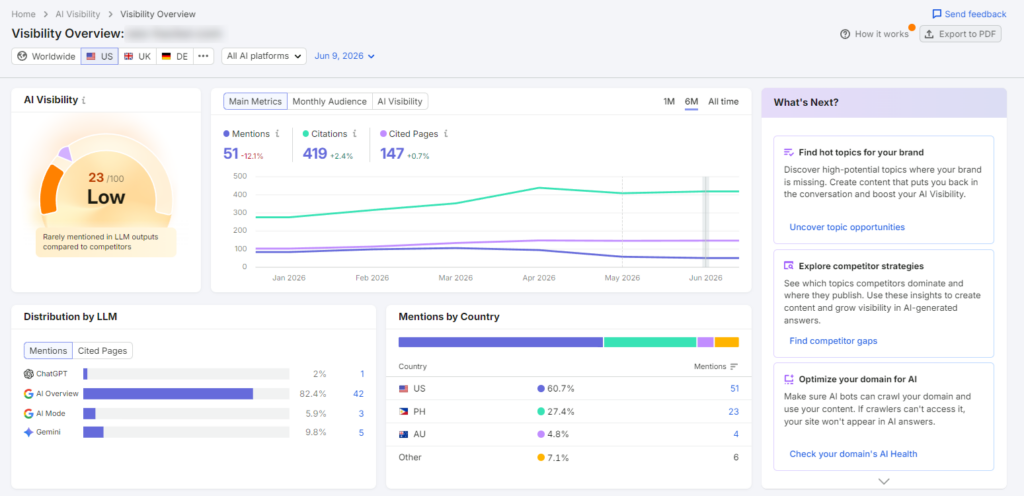
2. AI Visibility Overview
This is the feature that makes Semrush One different from the traditional SEO Toolkit.
The AI Visibility Toolkit shows how brands appear in AI-generated answers and helps marketers measure visibility beyond traditional search. Semrush says the toolkit helps benchmark AI visibility, analyze sentiment, discover prompts, track daily AI visibility, audit crawl blockers, identify competitive gaps, and generate reports.
For me, this is useful because AI answers often create a friction point. If AI mentions a brand but does not link to it, the user has to take an extra step: open Google, search the brand, find the correct site, and then convert. Every extra step can leak conversions.
That is why SEO, AEO, and GEO should work together. AEO and GEO helps the brand get mentioned. SEO helps capture the click when the user searches afterward.

3. AI Mentions and Citations
Semrush One helps track whether AI systems mention a brand and whether they cite the brand’s content.
That distinction matters.
A mention means AI talks about the brand.
A citation means AI references a source or page.
For reporting, I would not promise “rank #1 in ChatGPT.” That is not how this game works. I would report share of voice, citation frequency, sentiment, and prompt-level visibility instead.
That is the honest way to sell and measure AEO and GEO.
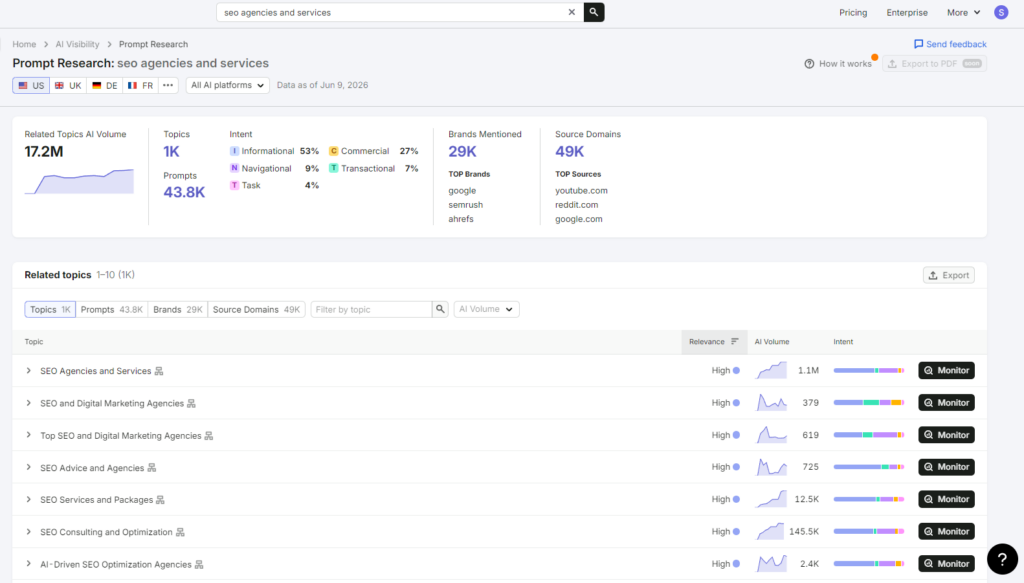
4. Prompt Research
Prompt Research is one of the most important Semrush One features because AI search behavior is question-led.
Traditional SEO starts with keywords like:
- “SEO agency Philippines”
- “best CRM software”
- “ecommerce SEO services”
AEO (and GEO) starts with questions like:
- “Who are the best SEO agencies for ecommerce brands?”
- “What should I look for when choosing an SEO company?”
- “Which CRM is best for a B2B sales team?”
Semrush’s AI Visibility Toolkit includes Prompt Research, which Semrush describes as a way to discover and prioritize AI search topics, including topic-level volume, difficulty, and user intent.
This is a major content strategy advantage. Instead of guessing what AI users might ask, I can build a question trail and create content that directly answers decision-stage questions.
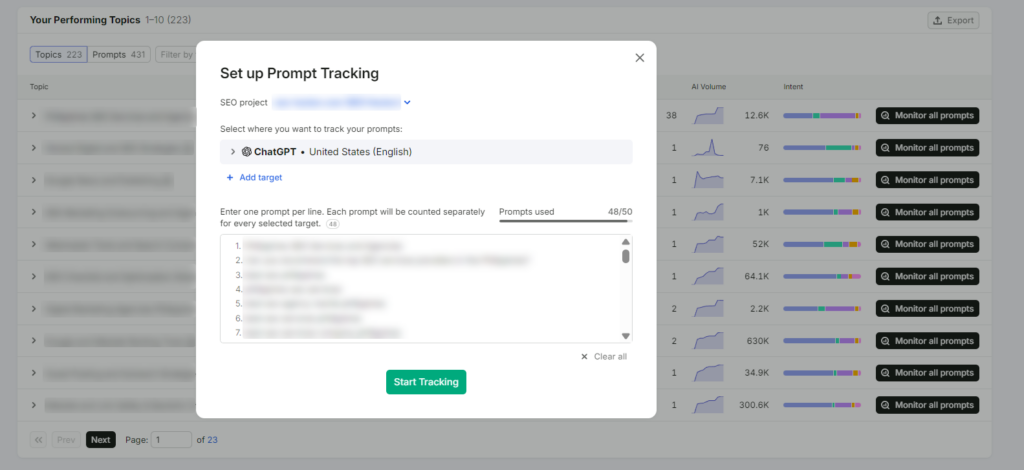
5. Prompt Tracking
Prompt Tracking lets me monitor important AI prompts over time.
According to Semrush’s Prompt Tracking documentation, the AI Visibility Toolkit alone includes 25 prompts per account, while Semrush One increases limits by tier: Starter includes 50 prompts and 500 daily tracked keywords, Pro+ includes 100 prompts and 1,500 daily tracked keywords, and Advanced includes 200 prompts and 5,000 daily tracked keywords.
That is useful because AEO and GEO are not a one-time optimization. AI answers can vary by platform, query wording, timing, and context. Prompt tracking gives me a repeatable way to monitor visibility without manually checking everything every day.
Still, I would treat the data as directional, not absolute. AI answers can change. Incognito versus logged-in behavior can differ. Sessions can produce different outputs. That is normal AI behavior, not necessarily a tool failure.
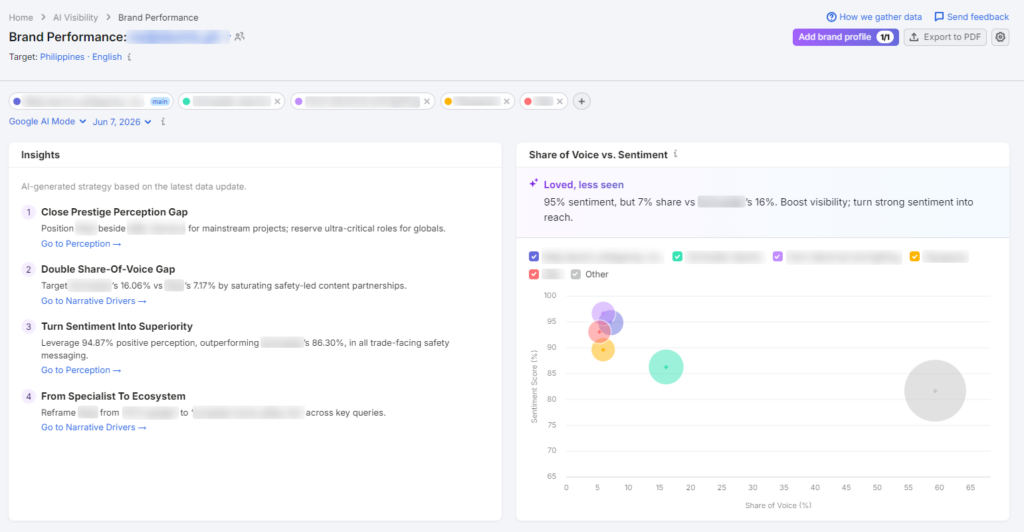
6. Brand Performance: Sentiment, Share of Voice, and Narrative Drivers
This is one of the more strategic parts of Semrush One.
It is not enough to know whether AI mentions my brand. I also want to know how AI describes my brand.
Does AI describe the brand as premium? Affordable? Reliable? Outdated? Local? Enterprise-ready? Beginner-friendly?
Semrush’s Brand Performance reports analyze share of voice, sentiment, and the narratives driving reputation, with AI-generated strategic recommendations.
This matters because AI tools are increasingly part of the buyer’s evaluation process. If AI summarizes a brand incorrectly, the brand may lose trust before the user ever reaches the website.
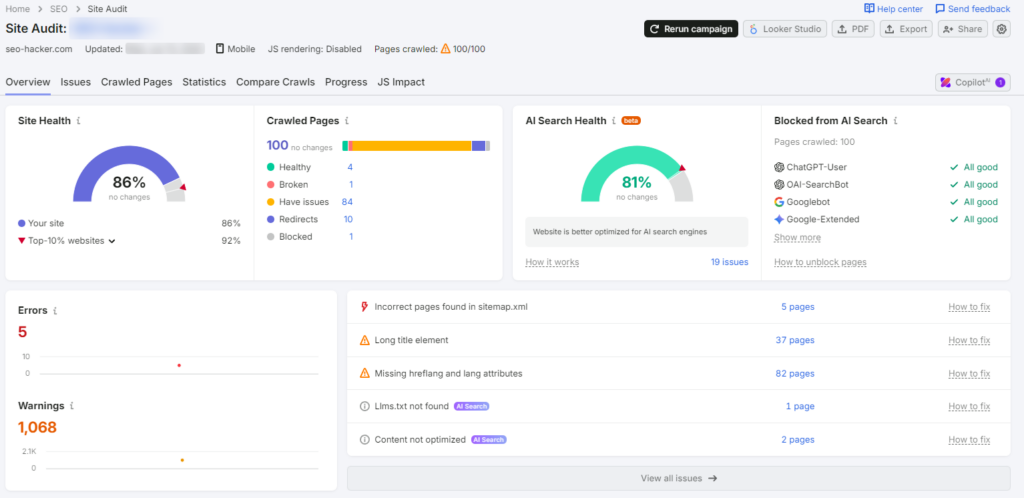
7. AI Search Site Audit
Semrush One also includes AI Search Health checks in Site Audit.
This is important because some pages may be technically acceptable for Google but still poorly structured for AI understanding. Semrush says its AI Search Site Audit checks for technical issues that might prevent AI bots from crawling content.
For AEO and GEO, I would pair this with strong on-page structure:
- Clear answer blocks
- FAQ sections
- Schema markup
- Author and updated dates
- Internal links
- Clean HTML
- Fast page speed
- Strong topical proof
- Comparison and decision criteria sections
AI does not just need content. It needs content that is easy to parse, verify, and summarize.
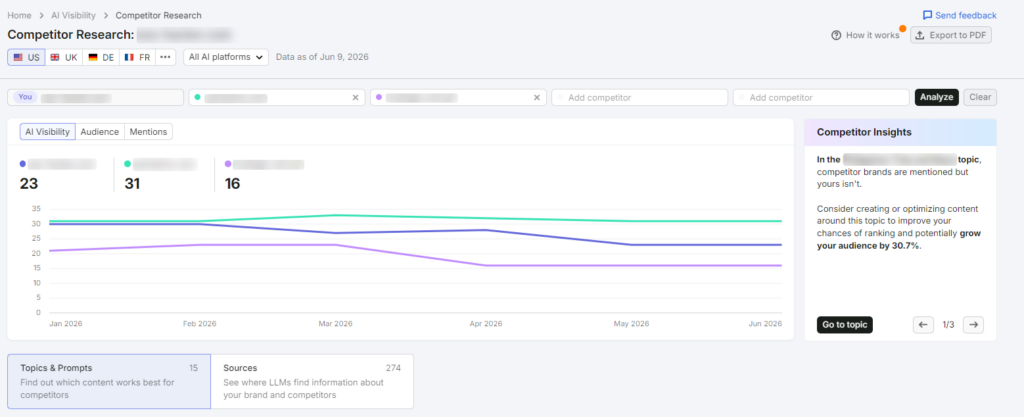
8. Competitor AI Visibility Analysis
Competitor analysis is one of the most valuable parts of Semrush One because AI visibility is competitive. It is not enough to know whether I am visible; I need to know who is visible instead of me.
A competitor may not outrank me in traditional search but may still appear more often in AI-generated answers. That means they are winning a different part of the discovery journey.
I use competitor AI visibility data to identify which competitors are mentioned, cited, and recommended for important prompts. Then I would study their cited pages, third-party mentions, content structure, and topical authority.
That turns competitor tracking into a practical content and authority roadmap.
Semrush One Pros & Cons
Pros
| Pro | Why It Matters |
|---|---|
| Combines SEO and AI visibility | I can track traditional rankings and AI discovery in one workflow |
| Strong AI Visibility Toolkit | Covers mentions, citations, share of voice, sentiment, prompts, and competitors |
| Includes full SEO Toolkit access | I do not lose keyword research, audits, backlinks, or rank tracking |
| Prompt Research is useful for AEO | Helps turn AI-style questions into content opportunities |
| Brand Performance reports are strategic | Shows how AI describes the brand, not just whether it mentions it |
| Good for agencies and reporting | Makes SEO + AI visibility easier to explain to clients or executives |
| Better annual value for committed teams | Annual Semrush One plans can narrow the gap versus monthly SEO Toolkit pricing |
Cons
| Con | Why It Matters |
|---|---|
| Upfront cost versus SEO-only plans | Semrush One starts at $199/month, which is higher than SEO-only plans. But for teams that need both SEO and AI visibility, it can still be competitive versus buying separate AI tracking tools. |
| Learning curve | The platform has a lot of tools and can overwhelm beginners |
| Extra users and add-ons can raise cost | Agencies should calculate total cost before committing |
| AI visibility is still evolving | No AI visibility tool can perfectly capture every AI answer or user journey |
| Prompt tracking limits vary by tier | Smaller plans may not be enough for larger agencies or multi-brand teams |
| Data should be validated | I would still cross-check key business decisions with GA4, Search Console, CRM data, and manual AI checks |
Mine and other third-party reviews I have reviewed generally agree with the pros and cons I’ve outlined here: Semrush is powerful, comprehensive, and useful, but pricing and complexity are common concerns.
It’s a future-focused upgrade that combines the classic SEO toolkit with AI visibility features, but its premium pricing and incomplete AI coverage may be considered a drawback for some SEOs and agencies looking for an AI visibility tool to add to their kit.
In conclusion: Semrush One can be a strong addition to your SEO toolkit, but it is best used by teams that need their data to scale, and will actually act on the data they get from the tool.
Semrush One Pricing Plans
Semrush One has three main plans: Starter, Pro+, and Advanced. Based on Semrush’s plan structure, Starter begins at $199/month, Pro+ is priced at $299/month, and Advanced is priced at $549/month when billed monthly.
Annual billing lowers the monthly equivalent. Starter comes down to around $165.17/month, Pro+ to around $248.17/month, and Advanced to around $455.67/month when billed annually.
| Plan | Monthly Price | Annual Equivalent |
|---|---|---|
| Starter | $199/month | $165.17/month, billed annually |
| Pro+ | $299/month | $248.17/month, billed annually |
| Advanced | $549/month | $455.67/month, billed annually |
Semrush One also has a seven-day free trial and annual savings of up to 17%.
When comparing pricing, it is important not to look only at the base subscription. The true cost depends on users, project limits, prompt tracking limits, add-ons, and whether the team needs advanced reporting or analytics tools.
For example, a solo consultant may only need one account. An agency with multiple strategists, account managers, and analysts may need several seats, which increases the monthly cost.
This is why I would calculate the total operating cost before buying. I would ask how many domains I need to track, how many users need access, how many prompts I need to monitor, and which add-ons are necessary.
That said, the annual pricing can make Semrush One more attractive. In some cases, the annual equivalent of a Semrush One plan comes close to the monthly price of the corresponding SEO Toolkit plan.
For teams already committed to AI visibility, the bundled pricing may make sense. For teams that only need traditional SEO, the SEO Toolkit remains the more cost-efficient choice.
Who Should and Shouldn’t Use Semrush?
Who Should Use Semrush One
Semrush One is a strong fit for:
- Agencies managing SEO and AEO clients. If clients are asking whether they appear in AI Overviews, ChatGPT, Gemini, or Perplexity, Semrush One gives you a reporting structure for that conversation.
- In-house SEO teams. If leadership is asking why rankings and traffic no longer explain the full picture, AI visibility data helps fill the gap.
- SaaS companies. SaaS buyers often ask comparison and recommendation questions. These are exactly the types of bottom-funnel prompts worth tracking.
- Ecommerce brands. Product research is shifting into conversational search. If AI recommends competitors but not your brand, you need to know.
- Publishers and content-heavy websites. If your business depends on content visibility, prompt research can help you build content around real AI-style questions.
- SEO professionals expanding into AEO/GEO. Semrush One gives SEOs a practical bridge from keyword-centric optimization to question-centric optimization.
Who Shouldn’t Use Semrush One
Semrush One may not be the best fit for:
- Small websites with tight budgets. If you are not yet acting on SEO basics, the AI layer may be premature.
- Solo bloggers who only need simple keyword research. A cheaper SEO tool may be enough.
- Teams that only report Google rankings. If no one cares about AI mentions, citations, or prompts yet, the SEO Toolkit may be the more cost-efficient option.
- Businesses without content execution capacity. AI visibility data is only useful if you can update pages, publish proof-led answers, improve technical structure, and build authority.
That last point is important. Semrush One can show the opportunity, but it cannot replace strategy, content quality, technical execution, or brand authority. Tools don’t win the game. Execution does.
Key Takeaway
Semrush One is one of the most practical platforms I’ve seen for the new search environment because it accepts the reality that SEO and AI visibility now belong together.
Google still matters. A lot. Traditional SEO is not dead, and any strategy that says “forget Google, just optimize for AI” is reckless. But AI-generated answers are now influencing how buyers discover, compare, and shortlist brands.
That is why Semrush One is valuable.
It gives me a way to answer modern visibility questions:
- “Do we rank?”
- “Are we cited?”
- “Are we mentioned?”
- “How are we described?”
- “Which competitors are AI choosing?”
- “What questions should we answer next?”
- “Where are the friction points between AI discovery and actual conversion?”
My final recommendation: Semrush One is worth it for teams that already take SEO seriously and now need to take AEO/GEO seriously too.
If your website is central to revenue, if your stakeholders are asking about AI search, or if you manage visibility for multiple brands or clients, Semrush One is a strong investment.
If you only need traditional SEO reports, start with the SEO Toolkit. But if you want to future-proof your visibility strategy, Semrush One is the better long-term choice.
FAQ About Semrush One
What is Semrush One?
Semrush One is a Semrush subscription that combines the core SEO Toolkit with the AI Visibility Toolkit. It helps users manage traditional search rankings, content performance, and AI-driven brand visibility from the same account.
How is Semrush One different from the Semrush SEO Toolkit?
The SEO Toolkit focuses on traditional SEO workflows like keyword research, rank tracking, backlinks, competitor analysis, and site audits. Semrush One includes those SEO features and adds AI Visibility features like AI mentions, AI citations, Prompt Research, Prompt Tracking, Brand Performance reports, sentiment, and share of voice.
Does Semrush One include the SEO Toolkit?
Yes. Semrush One includes the core SEO Toolkit along with the AI Visibility Toolkit.
Which AI platforms does Semrush One track?
Semrush’s comparison material says Semrush One tracks brand presence across AI Overviews, ChatGPT, Gemini, and Perplexity. Semrush’s AI Visibility Toolkit documentation also references monitoring AI visibility, prompts, sentiment, and competitors across AI systems.
Does Semrush One track prompts?
Yes. Semrush One includes Prompt Tracking. Semrush’s Prompt Tracking documentation lists limits by tier: Starter includes 50 prompts, Pro+ includes 100 prompts, and Advanced includes 200 prompts.
Is Semrush One good for AEO and GEO?
Yes. Semrush One is useful for AEO and GEO because it helps track AI mentions, AI citations, share of voice, prompts, sentiment, and competitor visibility. It is especially useful when paired with strong SEO execution, structured content, schema, FAQs, proof-led pages, and technical crawlability improvements.
Is Semrush One better than the SEO Toolkit?
Semrush One is better if AI visibility is part of your strategy. The SEO Toolkit is better if you only need traditional SEO features and want the lower-cost option.
How much does Semrush One cost?
Semrush One pricing starts at $199/month for Starter, $299/month for Pro+, and $549/month for Advanced based on Semrush’s plan comparison details. Annual billing lowers the monthly equivalent.
Who is Semrush One best for?
Semrush One is best for agencies, in-house SEO teams, SaaS companies, ecommerce brands, publishers, and SEO professionals who need to report on both traditional search visibility and AI visibility.
Is Semrush One worth it?
Yes, Semrush One is worth it if you need SEO and AI visibility in one reporting system. It is not the cheapest option, but it provides a strong bridge between traditional SEO and the new reality of AI-driven discovery.
The post Semrush One Review: Is It Worth It for SEO, AEO, GEO, and AI Visibility? appeared first on SEO Services Agency in Manila, Philippines.


