


Strong Google rankings no longer tell me the whole story. A company can rank well in traditional search and still be missing when customers ask ChatGPT, Gemini, Perplexity, or Google’s AI experiences to compare providers, recommend products, or suggest solutions.
It’s why learning how to track your brand in AI search is now a necessary extension of SEO and a core part of generative engine optimization (GEO). Benchmarking how your brand is performing is your first step to figuring out how to consistently get mentioned and cited in AI-generated answers.
I use Semrush One for AI brand monitoring because it combines Semrush’s SEO Toolkit and AI Visibility Toolkit in one workflow. I can research prompts, benchmark visibility, analyze competitors, monitor brand perception, track priority prompts, and check technical AI readiness without juggling separate tools. That beats tracking AI prompts manually and hoping my brand shows up.
TL;DR: How to Track Your Brand Across AI Search with Semrush One
My Semrush One workflow has six steps:
- Benchmark: Save your AI Visibility baseline in Visibility Overview.
- Research: Find the prompts your audience asks in Prompt Research.
- Compare: Surface missing prompts and missing sources in Competitor Research.
- Diagnose: Use Brand Performance and AI Search Health to find out why competitors win.
- Optimize: Fix the biggest cause first, whether that is content, citations, positioning, or technical access.
- Track: Monitor a stable set of priority prompts daily in Prompt Tracking.
What Does AI Brand Tracking Actually Measure?
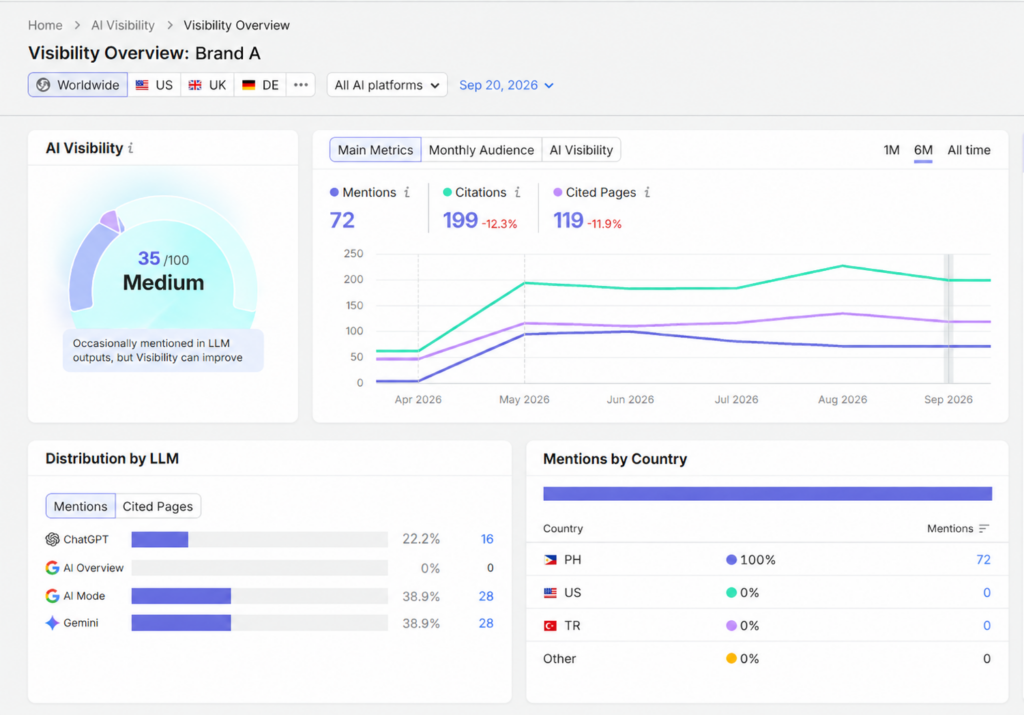
AI brand tracking measures how consistently and accurately a company appears across AI-generated answers. Inside Semrush One, I focus on several signals instead of one visibility number.
Metric What I Use It For AI Visibility Benchmarking overall presence in AI-generated answers. Mentions How often the brand appears for relevant topics and prompts. Cited Pages Pages that AI systems use as sources. Citations How frequently the domain supports AI-generated answers. Share of Voice Brand mentions compared with competitors. Sentiment How AI platforms describe the brand. Narrative Drivers Topics, questions, and sources shaping brand perception. Average Position Where the domain's citations appear for tracked prompts. Prompt Visibility Changes across a defined set of important AI prompts.
These metrics answer different questions. A brand may have strong citation visibility from informational content but weak Share of Voice on commercial prompts where users compare providers, so I look at where it appears, why, and whether it shows up when buying decisions are being made.
Why Traditional Rank Tracking Isn’t Enough
Rankings, clicks, and conversions still show me which keywords and pages perform. But AI platforms add another discovery layer. Instead of a fixed list of blue links, they summarize information, compare providers, cite multiple sources, and recommend specific options or leave a company out entirely, which creates situations like these:
- A brand ranks well on Google but gets few AI mentions.
- A competitor is recommended often without dominating rankings.
- A website is cited repeatedly, but the company has weak Share of Voice.
- Strong SEO content supports AI answers without building the positioning the company wants.
That’s why I run this analysis in Semrush One, which puts traditional SEO and AI visibility in one environment so I can see how the two interact. For my full take, read my Semrush One review for SEO, AEO, GEO, and AI visibility.
Step 1: Establish Your AI Visibility Baseline in Semrush One
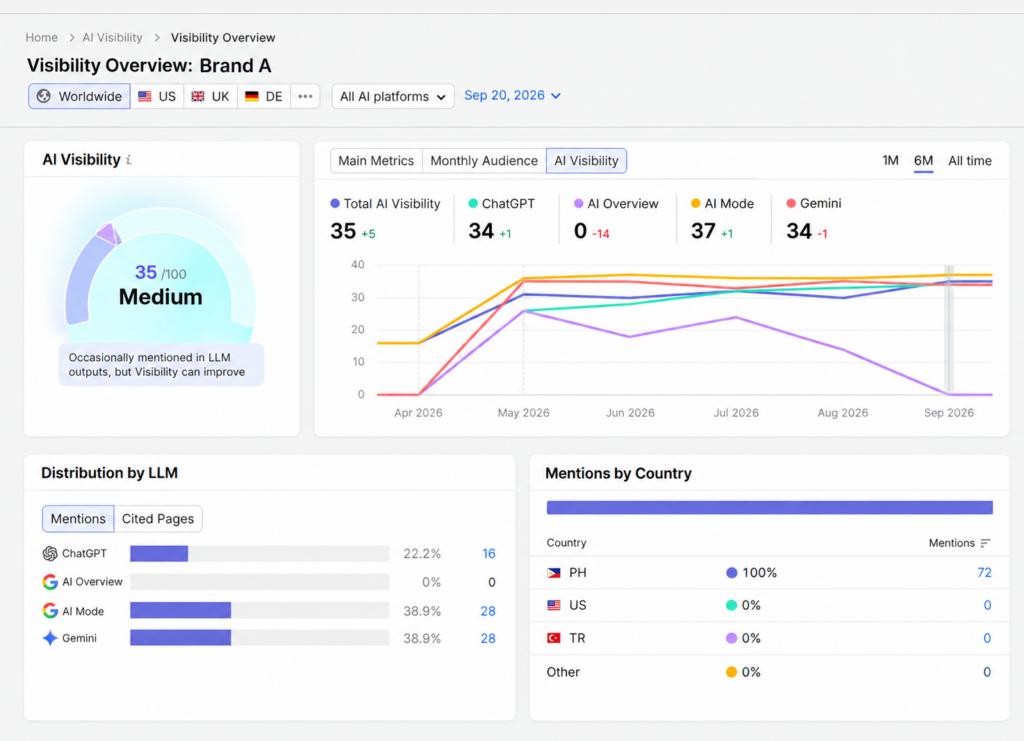
I start with Visibility Overview, the fastest way to see a brand’s AI footprint before changing content, technical elements, or off-site strategy. I review the AI Visibility Score, Mentions, Cited Pages, Citations, trends, performing topics, distribution by LLM, and geographic mentions.
I save this baseline before making major optimizations. Otherwise, I can’t tell whether later changes improved AI search visibility or whether I’m just reacting to individual AI responses.
Step 2: Find the AI Prompts That Actually Matter
A common mistake is building a prompt list entirely around the brand. Prompts like “What is [Brand]?” help with perception monitoring but don’t show whether someone can discover the company before knowing its name.
For discovery, I use Prompt Research in Semrush One. I enter a category, product, service, or industry topic and get related prompts with AI Volume, intent, relevant brands, and source domains. My guide on transitioning to prompt research further explains how this builds on keyword research.
Category Discovery Prompts
These show whether the brand appears when someone is exploring the market. Example: “What are the best [product/service] providers?”
Problem-Solution Prompts
These reveal whether the company appears before the user has chosen a type of solution. Example: “Which companies can help with [problem]?”
Comparison and Decision Prompts
These matter most because the AI platform is evaluating alternatives. Examples: “[Brand A] vs. [Brand B]” and “What are the alternatives to [competitor]?”
Prompt Research also shows intent, so I can separate informational questions from commercial ones. I prioritize prompts where appearing in the answer would matter to the business, not just prompts with measurable demand.
Step 3: Compare Your Brand Against AI Competitors
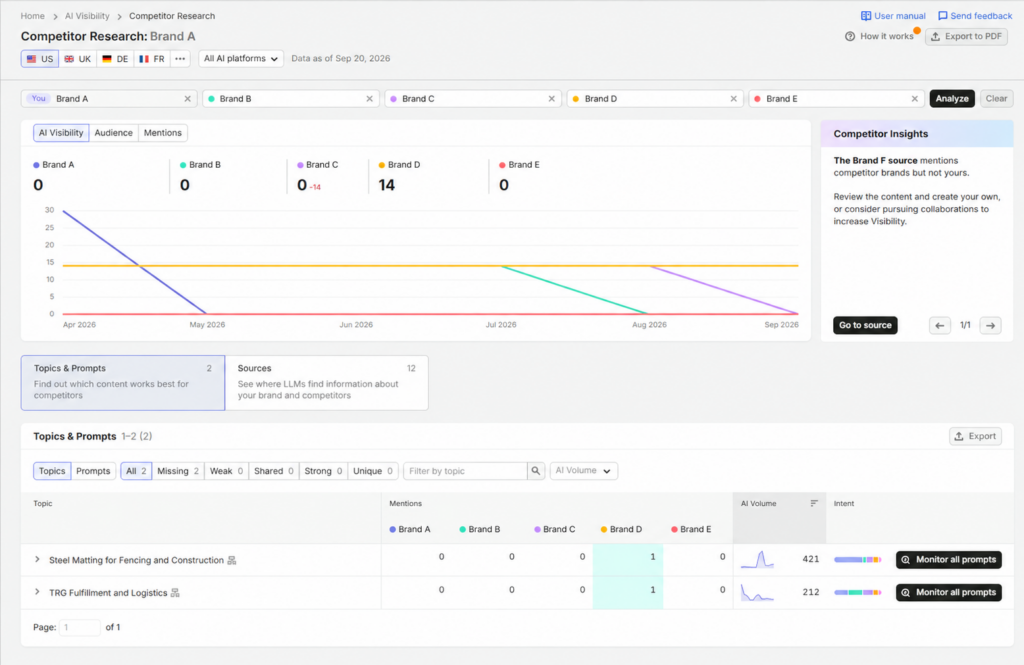
Once I know what the market is asking, I move to Competitor Research, where AI brand monitoring becomes more useful than counting mentions. It compares a domain with competitors across AI visibility, mentions, citations, topics, prompts, and sources, and flags prompts where competitors appear but the brand doesn’t. I look for two types of gaps, and I previously covered this in my guide on how to find AI visibility gaps before your competitors do.
Missing Prompts
These are relevant prompts where competing brands appear and mine doesn’t. They usually point to content or positioning opportunities.
Missing Sources
These are sources cited where competitors appear and my brand doesn’t, which suggests the problem may not sit on the company’s own website. If competitors earn citations from publishers, directories, or industry resources, the fix may be a stronger external presence, so I reverse engineer competitor citations in AI search.
Step 4: Measure Share of Voice and Brand Perception
Visibility alone doesn’t show how a brand is represented, so I use Brand Performance. It analyzes Share of Voice, sentiment, questions, and narrative drivers across ChatGPT, Gemini, Perplexity, Google AI Mode, and Google AI Overviews.
These reports show how much of the AI conversation the brand owns, which competitors have more Share of Voice, and whether the company is described positively, neutrally, or negatively. Narrative Drivers are especially helpful because a mention count only tells me the brand appeared, while narrative analysis shows why and which themes and domains shape the answer.
Step 5: Track Priority Prompts Over Time
Research shows me the opportunities, and tracking shows whether the strategy works. I send the most commercially relevant prompts to Prompt Tracking, which monitors custom prompts daily across supported AI search environments, including ChatGPT Search, Google AI Mode, and Gemini. It shows visibility, Average Position, competitor performance, and which domains or pages get cited.
I use the broader reports to understand the market and Prompt Tracking for the smaller set worth monitoring, such as prompts tied to core services, priority products, important locations, high-intent comparisons, and revenue-driving customer problems. Here’s how I decide which AI search prompts to track. Consistency matters, too, because swapping the tracked prompts every reporting period makes it impossible to tell whether visibility actually improved.
Step 6: Diagnose Why Competitors Appear Instead of You
This is where the Semrush One workflow becomes actionable. Knowing another brand appears more often isn’t enough, so I investigate what’s causing the difference.
Area Semrush One Workflow Prompt Coverage Identify missing topics and prompts with Prompt Research and Competitor Research. Brand Visibility Compare Mentions and AI Visibility in Visibility Overview. Competitive Position Review competitor gaps and Share of Voice. Brand Perception Analyze Brand Performance and Narrative Drivers. Citations Review Cited Pages, Sources, and Missing Sources. Technical Access Review AI Search Health and crawler accessibility. Long-Term Performance Monitor priority prompts through Prompt Tracking.
This keeps me from assuming every AI visibility problem needs new content. The cause might be missing content, an unclear page, weak third-party mentions, or blocked crawlers, and understanding how LLMs choose which brands to recommend helps me decide what to check first.
Step 7: Check Your Technical Readiness for AI Search
Strong content won’t help if AI search crawlers can’t access it, so I include AI Search Health in the workflow. Inside Semrush Site Audit, it checks technical factors like crawler access, structured data, and internal linking, and it can identify pages blocked from major AI crawlers. I review:
- AI Search Health
- Pages blocked from AI search
- AI crawler access and relevant robots.txt restrictions
- Structured data issues
- Internal linking and crawlability problems
- AI-specific Site Audit warnings
I do this after the visibility analysis because an audit is more useful once I know which pages matter. If an important service page is missing from AI answers and crawlers can’t reach it, I have a specific issue to fix.
Step 8: Turn the Data Into an Optimization Workflow
By this point, Semrush One has shown me where the brand stands, what users ask, where competitors are stronger, and which technical blockers exist. I match what I find to one of these situations so I’m never optimizing blindly.
If the Brand Is Missing From Important Prompts
I check whether the site covers the topic and whether the brand is clearly connected to it. The fix may be a new landing page, stronger service copy, a comparison resource, or FAQ content. I use this update vs. create content framework for AEO and GEO to choose, then map each prompt to a page with intent-to-answer mapping.
If Competitors Have Stronger Citation Coverage
I inspect the domains and pages supporting their visibility. This can reveal opportunities for original research, external brand mentions, digital PR, or clearer expertise signals.
If the Website Is Cited but the Brand Is Rarely Recommended
I investigate the positioning. The content may be useful enough to become a source without explaining why the company itself should be considered.
If Visibility Is Strong but Sentiment or Positioning Is Weak
I use Brand Performance and Narrative Drivers to identify which attributes and sources shape how AI describes the brand. That tells me which themes to address first.
If Important Pages Are Technically Restricted
I prioritize the relevant Site Audit issues before expecting content changes to help. Content can’t earn citations from crawlers that can’t reach it.
How I Track ChatGPT, Gemini, Perplexity, and Google AI
I don’t treat every AI platform as the same ranking environment, so I use different Semrush One reports depending on the analysis I need.
ChatGPT
I review which topics and prompts trigger mentions, which sources get cited, and how performance compares with competitors. Important prompts go into Prompt Tracking.
Gemini
I compare Gemini visibility with other AI platforms to see whether they rely on different topics, pages, or sources. Important Gemini prompts also go into Prompt Tracking.
Perplexity
I analyze Perplexity mainly through Brand Performance, especially Share of Voice, perception, questions, and brand narratives. It shows how the company is represented outside traditional search.
Google AI
I treat Google AI Overviews and AI Mode as separate surfaces. Semrush One provides visibility data for both, and Prompt Tracking covers selected AI Mode prompts.
How to Measure and Report AI Visibility Growth in Semrush One
I save the starting benchmark before making major changes, then watch how the Semrush One metrics develop. Since AI-generated answers change, I don’t judge success because the brand appeared once after publishing an article. I look for broader patterns:
- More priority topics and previously missing prompts surfacing the brand
- Share of Voice increasing against relevant competitors
- More strategic pages receiving citations
- Better visibility for tracked high-intent prompts
- Stronger, more accurate narratives and fewer technical barriers for AI crawlers
Semrush’s broad AI datasets and custom Prompt Tracking update at different frequencies, so I rely on trends over isolated movements. For a deeper look at the metrics, see my guide to measuring AEO performance.
For reporting, I organize around business questions instead of pasting every metric, covering visibility, competitor gaps, content opportunities, external authority, technical access, and progress on tracked prompts. Semrush One supports exports for several AI Visibility reports, and its My Reports integration brings AI visibility data into stakeholder-ready reporting.
Common AI Brand Tracking Mistakes
Several mistakes can make AI visibility data less useful. These are the ones I watch for.
Tracking Only Branded Prompts
This shows whether an AI platform recognizes the brand, not whether customers can discover it. Add non-branded prompts from Prompt Research.
Treating AI Visibility as One Metric
A strong AI Visibility Score doesn’t tell the whole story. Review mentions, citations, Share of Voice, sentiment, and competitors separately.
Tracking Every Prompt You Can Find
More data doesn’t create a better strategy. Use Prompt Research to find opportunities, then reserve Prompt Tracking for prompts that matter to the business.
Ignoring the Sources Behind Competitor Visibility
A competitor gap may be an authority problem, not a content problem. Use Competitor Research and Narrative Drivers to investigate the domains shaping answers.
Changing Your Tracked Prompts Constantly
This weakens your benchmark. Keep a stable core set so changes stay comparable over time.
Assuming Every Gap Requires a New Article
First determine whether the problem is content coverage, positioning, citations, entity clarity, or technical access. Semrush One has a report for each.
Looking at AI Visibility Separately From SEO
AI search is another discovery environment, not a reason to abandon traditional search. Understanding how AEO and GEO differ helps, since both expand SEO rather than replace it.
Key Takeaway
I don’t start AI brand monitoring by manually asking whether an AI platform knows the company. To understand how to track your brand in AI search, I first save a baseline in Semrush One, then use Prompt Research, Competitor Research, Brand Performance, Prompt Tracking, and AI Search Health to find visibility gaps, measure perception, and catch technical issues.
The process is to benchmark, research, compare, diagnose, optimize, and track. The real value isn’t knowing the brand appeared. It’s knowing which topics make it visible, which competitors appear instead, which sources shape those answers, and how AI describes the company, so I know what to change next.
Frequently Asked Questions About Tracking Your Brand in AI Search
How do I track my brand across ChatGPT, Gemini, Perplexity, and Google AI?
Use Semrush One to benchmark your domain in Visibility Overview, find prompts in Prompt Research, and compare competitors in Competitor Research. Then measure Share of Voice and sentiment in Brand Performance and monitor priority prompts in Prompt Tracking.
What is the difference between an AI mention and an AI citation?
A mention means an AI answer names your brand. A citation means it uses your website as a source. A brand can have one without the other, so I track them separately.
How often should I check my AI visibility?
Prompt Tracking checks custom prompts daily, but I review trends instead of individual movements because AI answers change. I compare results against my saved baseline each reporting period.
The post How to Track Your Brand Across ChatGPT, Gemini, Perplexity, and Google AI with Semrush One appeared first on SEO Services Agency in Manila, Philippines.


