


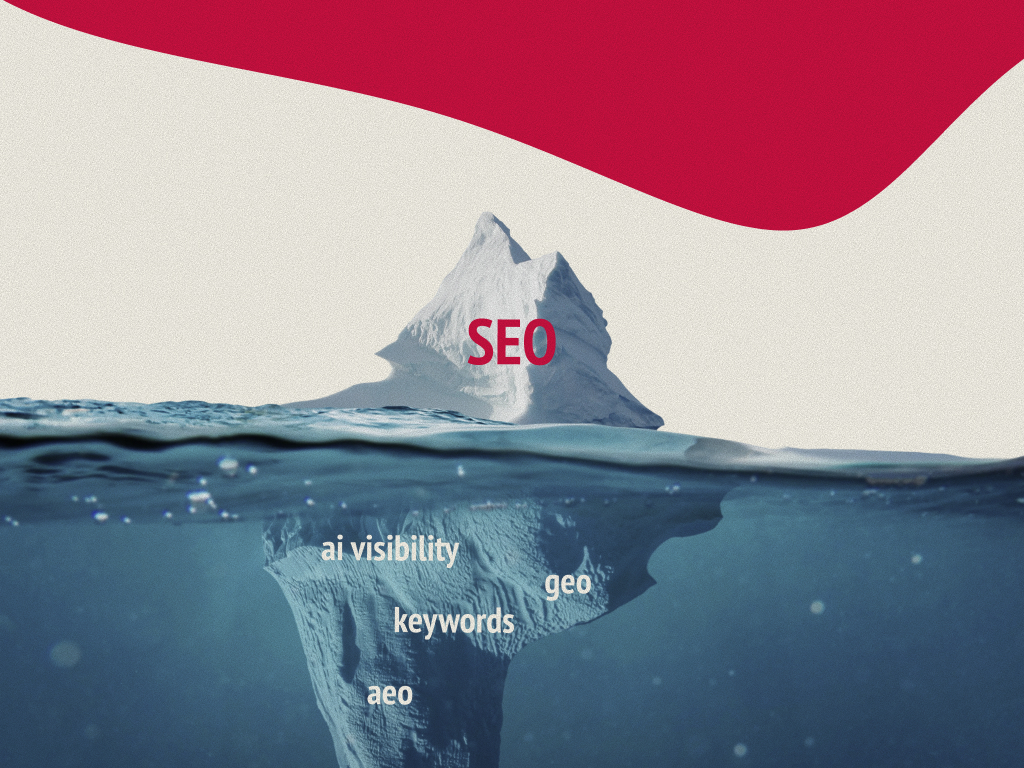
Ever since Google started introducing AI into its search results, one thing has become clear to me: SEO best practices and AI search optimization aren’t as different (or as complicated) as some people make them out to be.
Creating useful content, understanding search intent, building authority, and making your website accessible to search engines still matter.
What has changed is how and where people discover information.
For example, your website could be ranking well on Google, but when someone asks ChatGPT, Gemini, or Perplexity to recommend a product or service, your business might not even get mentioned.
That’s a visibility gap you can’t afford to ignore. And that’s where Answer Engine Optimization (AEO) and Generative Engine Optimization (GEO) come in.
Having worked in SEO for over 15 years, I don’t see AEO and GEO as replacements for traditional SEO. I see them as extensions of what we’ve already been doing, with additional considerations for how AI-powered search systems find, understand, and reference content.
So, what should you actually be doing differently?
Here are seven best practices I recommend to help your website stay visible across both Google and AI-powered search.
What Is the Difference Between SEO, AEO, and GEO?
Before I discuss best practices, it’s important to understand what each approach actually does.
Approach Primary Focus Practical Application SEO Organic search visibility Rankings, crawlability, content relevance, and organic traffic AEO Direct, accessible answers Clear explanations, question-based headings, and structured format GEO Generative AI visibility Brand mentions, citations, credible references, and topical relevance
For example, a well-researched article that answers questions clearly, demonstrates expertise, and earns relevant backlinks can support all three.
The important thing is understanding which practices help your content get discovered on Google, which make it easier to answer questions, and which improve its chances of being referenced by AI.
That’s what I’ll focus on in the following seven best practices.
Why SEO Is Still the Foundation of AI Search
One misconception I often hear is that AI search requires an entirely different optimization strategy from SEO.
I disagree.
Even Google’s own guidance on AI search confirms that established SEO best practices still apply to AI Overviews and AI Mode. Creating original, helpful content, maintaining technical accessibility, and providing a good user experience remain essential.
But here’s the catch: ranking well on Google doesn’t guarantee visibility in AI-generated answers.
I’ve explored this in my article on whether brands ranking on Google also win in ChatGPT.
For example, your website might rank on Google’s first page for a competitive keyword but never get mentioned when someone asks ChatGPT to recommend service providers in your industry.
Does that mean your SEO isn’t working?
Not necessarily.
Your content might be missing information that AI users are asking about. Your competitors might have stronger brand mentions across third-party websites. Or the AI platform might simply be retrieving different sources.
My approach isn’t to abandon what’s already working in SEO. It’s to investigate why the brand isn’t appearing in AI answers and address those gaps.
SEO, AEO, and GEO Best Practices I Recommend
Before optimizing anything, I want to understand what’s working, what isn’t, and why. After all, there’s no point implementing new strategies if they don’t solve the actual problem.
With that in mind, here are seven best practices I recommend for improving visibility across Google and AI search.
1. Start With Search Intent, Not Just Keywords
Keyword research is still important, but I wouldn’t build an entire SEO strategy around search volume alone. I want to understand what people are actually trying to accomplish when they search (aka, their search intent).
Consider these two queries:
- “Best CRM software”
- “Which CRM is best for a small business with five employees and a limited budget?”
Both are looking for CRM recommendations, but the second gives us more context about what the person needs.
And that’s something I pay particular attention to with AI search. People can ask detailed, conversational questions instead of relying on a few keywords.
When researching a topic, I look at:
- The intent behind the keyword.
- Questions people ask before making a decision.
- Comparisons and requirements that influence their choices.
- Gaps between existing content and what readers actually need.
Once I’ve identified these, I incorporate the relevant answers into existing pages where they fit, rather than creating a separate article for every possible AI prompt.
That’s how I align content with search intent while making it more useful for both Google and AI search.
2. Write Direct Answers Supported by Actual Expertise
One thing I always recommend is making answers easy to find.
If someone searches for the difference between SEO, AEO, and GEO, they shouldn’t have to read five paragraphs just to understand it.
Give the answer first, then explain why it matters.
But here’s the thing: AI can already summarize information that’s available all over the internet. What makes your content stand out is the experience, examples, and evidence you bring into it.
For example, instead of simply telling readers to update their content regularly, explain how to identify which pages actually need updating. Look at historical clicks, impressions, ranking changes, and whether the information is still accurate.
That’s advice someone can actually use.
I also recommend including firsthand observations, original data, screenshots, and real examples wherever relevant. Don’t be afraid to explain exceptions or situations where a particular strategy might not work.
The goal isn’t to write the longest article. It’s to give readers an answer they can understand, trust, and act on.
3. Organize Content for Readability and Retrieval
Even the most informative article won’t be very useful if readers have to dig through walls of text to find what they need.
That’s why I always recommend keeping content well-organized and easy to navigate.
Some of the practices I follow include:
- Using clear, descriptive H2 and H3 headings.
- Answering important questions early in each section.
- Breaking down complicated processes into actionable steps.
- Using tables to explain comparisons.
- Adding relevant schema markup that accurately reflects the page’s content.
These practices make content easier to read and help search engines understand how information is organized.
But here’s something I want to make clear: adding FAQs or schema markup doesn’t guarantee your content will appear in AI-generated answers.
In fact, Google’s guidance on AI search specifically states that you don’t need special structured data to appear in AI Overviews or AI Mode.
For me, the rule is simple: structure your content to help people understand it, not to trick search engines or AI into recommending it.
4. Build Topical Authority Through Internal Linking
When I evaluate a website, I don’t just look at individual pages. I look at how the entire website is structured and how its content connects.
For example, an SEO website covering AI search should have relevant articles about technical SEO, keyword research, search intent, content optimization, and AI visibility.
Each article should answer a specific question while supporting the website’s overall expertise on the subject.
This is where internal linking helps build topical authority. By connecting related articles, you’re helping readers discover useful information while making it easier for search engines to understand the relationships between your pages.
But here’s something I always tell people: more content doesn’t automatically mean better SEO.
If you’re publishing several articles that answer essentially the same question, you risk keyword cannibalization and unnecessary content overlap.
Sometimes, updating an existing article and strengthening its internal links makes more sense than publishing another one.
The goal isn’t to have the most pages. It’s to make sure every page serves a purpose.
5. Strengthen Credibility Through Sources and Brand Mentions
When evaluating content, I don’t just ask whether the information is accurate. I also ask: Why should someone trust it?
This is where real experience, credible sources, accurate information, and clear authorship matter. These are also qualities reflected in Google’s E-E-A-T framework, although E-E-A-T itself isn’t a single ranking factor.
But with AI search, I also look at what other websites are saying about a brand.
Think about two software companies offering similar products. One only talks about its services on its own website. The other also gets mentioned in industry publications, independent reviews, and relevant comparison articles.
Which one has more opportunities to be discovered and referenced by AI?
Potentially, the second one.
That’s why I consider backlinks, credible third-party mentions, and original research important when building brand authority for AI search.
Of course, getting more mentions doesn’t automatically guarantee AI citations or recommendations.
The goal isn’t to get your brand mentioned everywhere. It’s to earn mentions from sources that are relevant, credible, and trusted by your audience.
6. Make Sure Search Engines and AI Crawlers Can Access Your Content
Before assuming an article needs rewriting, I check whether search systems can access it properly. A technically restricted page may struggle regardless of how useful its content is.
My initial technical checks include:
- Indexability and noindex directives
- Robots.txt restrictions
- Canonical tags
- Internal linking
- Redirects and broken URLs
- Important content hidden behind rendering issues
AI crawler access also deserves attention, but not every AI crawler serves the same purpose. Some retrieve information for search experiences, while others collect data for model training. Those permissions should be evaluated separately based on the website’s objectives.
The important point is that technical SEO remains fundamental.
If important content cannot be reliably crawled or indexed where required, adding more keywords or rewriting headings won’t address the underlying issue.
7. Refresh Content Based on Performance, Not Just Age
I don’t recommend refreshing articles simply because they were published six months ago.
I would first check whether their performance or usefulness has changed.
For example, a page might have declining organic clicks because competitors published better resources, its information became outdated, or search intent shifted.
Those situations require different solutions.
As I explain in my guide on how to fix content decay, diagnosis should come before editing.
I normally review:
- Historical clicks and impressions
- Keyword ranking movements
- Current search results
- Competing content
- Outdated facts and examples
- Changes in internal links or backlinks
And if the content is still accurate, relevant, and performing well? I might not touch it at all.
How to Measure SEO and AI Search Visibility
One thing I’ve learned from managing SEO campaigns is that ranking well on Google doesn’t necessarily mean your brand is visible in AI search.
That’s why I measure both.
I still use Google Search Console and Google Analytics 4 to track organic traffic, search performance, and conversions. But I also want to know whether my clients’ brands appear when potential customers ask AI platforms for recommendations.
Here’s what I look at:
Area What I Measure Tools Traditional SEO Keyword rankings, organic clicks, impressions, CTR Google Search Console, Semrush One Website Performance Organic sessions, engagement, leads Google Analytics 4 AI Search Visibility Brand mentions, citations, Share of Voice Rankseer, Semrush One Competitive Visibility Missing prompts, competitor mentions, cited sources Rankseer, Semrush One
Use Semrush One to Identify SEO and AI Visibility Gaps

I’ve always relied on Semrush One when I want to connect traditional SEO performance with AI search visibility. Beyond just tracking keyword rankings, Semrush One allows me to investigate relevant AI prompts, compare competitor visibility, identify citation gaps, and understand where competing brands appear instead.
For a more detailed process, I’ve also covered how to track your brand across AI search using Semrush One, including establishing visibility baselines, researching relevant prompts, comparing competitors, and monitoring changes over time.
For example, if a website ranks well for an important service keyword but rarely appears in AI-generated recommendations, I can investigate whether competitors have stronger content coverage or more relevant external references.
That gives me a clearer direction for optimization rather than automatically recommending another article.
Use Rankseer to Monitor Brand Visibility Across AI Search
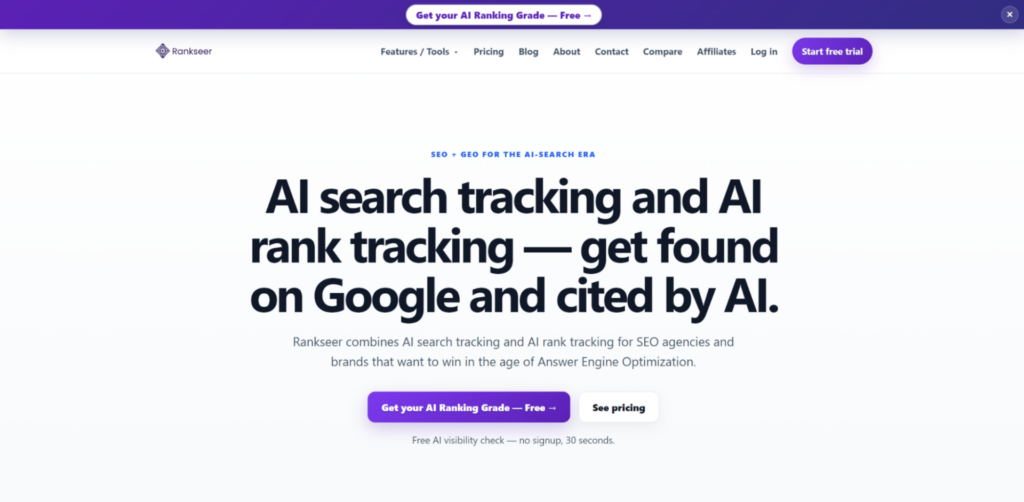
For ongoing AI search monitoring, I use Rankseer to measure how visible a brand is compared to its competitors across different AI platforms.
What I find particularly useful is its ability to track and benchmark AI Share of Voice (SOV) across ChatGPT, Perplexity, Gemini, Claude, and Google’s AI Overviews.
This gives me a clearer picture of how often my clients’ brands are mentioned or cited compared to their competitors, and which platforms they’re gaining or losing visibility on.
For example, a client might have strong visibility on ChatGPT but barely appear in Gemini or Google’s AI Overviews. Instead of guessing what needs improvement, I can use Rankseer to identify where competitors are getting mentioned, which sources are being cited, and where our biggest visibility gaps are.
And that’s where I think Rankseer becomes especially valuable.
Beyond tracking performance, I also use its content gap analysis and AI content creation tools to identify missing topics, develop new articles, and improve existing pages based on what our audience is actually searching for.
Rather than checking a single AI response and calling it a day, I monitor a consistent set of commercially relevant prompts over time. AI responses can vary, so I use these benchmarks to identify trends rather than treat them as guaranteed rankings.
That’s how I turn AI visibility data into actionable SEO, AEO, and GEO strategies.
Common SEO, AEO, and GEO Mistakes to Avoid
Now that I’ve covered the practices I recommend, I also want to point out a few mistakes I’ve seen businesses make, especially as they try to adapt to AI search.
- Treating SEO, AEO, and GEO as completely separate strategies. There’s a lot of overlap, and separating them unnecessarily can lead to duplicated work.
- Chasing AI citations that don’t matter. Getting mentioned by ChatGPT is great, but if the prompt has nothing to do with your business or potential customers, what’s the point?
- Assuming every visibility gap needs a new article. Sometimes the problem is technical SEO, missing information, weak brand authority, or content that already exists but needs improvement.
- Expecting guaranteed AI recommendations. Just like Google rankings, nobody can guarantee that an AI platform will consistently recommend your brand.
- Relying on a single visibility score. Rankings, traffic, AI Share of Voice, and citations tell you different things. You need to understand what each metric actually means.
My advice? Figure out what’s causing the problem before deciding how to fix it.
There’s no point spending time and resources on strategies that don’t address what’s actually holding your visibility back.
Key Takeaway
I don’t believe businesses need to reinvent their entire SEO strategy just because AI search is becoming more of a necessity in this new era of search.
The fundamentals still matter. Creating useful content, understanding search intent, maintaining a technically sound website, and building credibility are just as important today.
What has changed is how people find information and make decisions.
Someone might discover your business on Google, encounter it in an AI-generated answer, or use both before deciding to contact you.
That’s why I recommend building on your existing SEO strategy while paying attention to where your brand appears in AI search and where your competitors are getting recommended instead.
Search will continue to evolve. But the goal hasn’t changed: make your business easy to find, easy to trust, and worth choosing.
The post SEO Best Practices That Still Matter in the Age of AI Search appeared first on SEO Services Agency in Manila, Philippines.


