


If you’ve spent years climbing Google’s rankings, you’d expect those rankings to carry over into ChatGPT, Gemini, and Google’s AI answers. Does it?
We tested it in one industry. Using Semrush One, we pulled organic keyword data and AI visibility data for 10 laptop brands, then compared them across seven sample searches a laptop buyer would actually make.
TLDR:
Ranking on Google and appearing in AI answers are linked, but not the same thing. In our data, the brands that led in both Google keywords and AI prompts were more likely to come out ahead overall. However, ranking high on Google does not mean a brand will also rank or be recommended on ChatGPT (or on other LLM-generated answers). Several brands with strong Google rankings had much weaker AI visibility for the same buyer questions. Others did the opposite. This is hard proof of what I’ve been saying the last year: SEO and AI visibility have to be built together.

The Market Backdrop: Buyers Are Searching and Asking at Scale
Laptop research is no longer happening in only one place. A buyer may start on Google, watch YouTube reviews, check Reddit threads, compare product pages, and then ask ChatGPT or Gemini which laptop is best for their specific situation. That is normal buyer behavior now.
For each of the themes we studied, Semrush showed both large Google keyword pools and large AI prompt pools.
Theme Google keywords in the pool Google search volume Avg. keyword difficulty AI prompts AI volume “laptop” 260.5K 16.7M 44% 52.2K 13.5M “best laptop” 234.6K 16.6M 49% 47.7K 13.4M “laptop comparison” 238.7K 14.7M 43% 51.7K 14.6M “laptop for work” 264.6K 17.6M 43% 47.7K 12.8M “laptop for remote work” 224.5K 18.4M 42% 46.2K 12.6M “laptop for student” 281.4K 18.3M 46% 47.4K 13.1M “laptop for gaming” 272.7K 20.7M 43% 46.4K 12.8M
Three things immediately stood out from the data.
First, Use-Case Searches Are Big Markets, Not Tiny Long Tails
A lot of people still think use-case searches are small. They are not.
“Laptop for gaming” had the largest Google volume of any theme we studied at 20.7M. It was followed by “laptop for remote work” at 18.4M and “laptop for student” at 18.3M. These are not obscure searches hiding at the edge of the market. These are massive buying categories.
Even when you zoom in to specific keywords, the numbers are still meaningful. “Best laptops for students” had about 135K monthly searches. “Best laptops for work” and “best laptops for gaming” each sat around 40K. That matters because these are not just traffic opportunities. These are decision opportunities.
Second, AI Prompts Look More Like Decisions Than Keywords
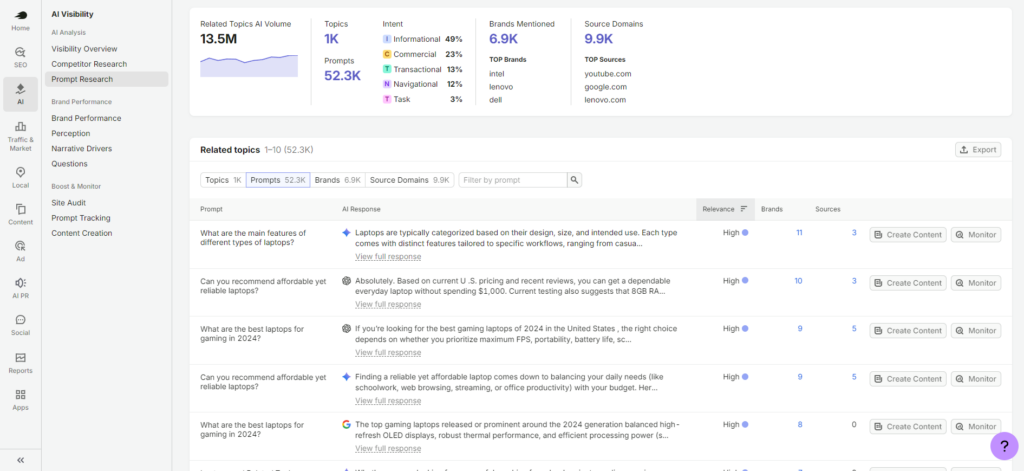
This is one of the most important shifts. Keywords are often short, but AI prompts are usually more complete and more contextual. A buyer might search Google for “best laptop for work,” but in ChatGPT or Gemini, that same buyer may ask, “What is the best laptop for remote work, Zoom calls, spreadsheets, and travel?”
That is a different kind of search behavior. Across the AI prompt sets we studied, roughly 46% to 49% of prompts were informational. Around a quarter were commercial for most themes, with another 12% to 14% transactional. But here is the catch: many of the “informational” AI prompts were still decision-stage questions.
Questions like “Is ASUS or MSI better for gaming?”, “Should I get a MacBook or a Windows laptop for work?”, “What laptop brand is best for students?”, “Which laptop is better for remote work?”, and “Is Lenovo better than Dell for business use?” may be informational on paper, but they are commercial in reality. The user may not be typing “buy now,” but they are clearly moving toward a shortlist.
That is why ranking for “laptop comparison” on Google and appearing in an AI answer about comparing laptops are related achievements, but not identical ones. Google may reward a page that targets the phrase well. AI may reward the brand that is consistently described across the web as the better fit for that specific use case.
AI Answers Pull From More Than Brand Websites
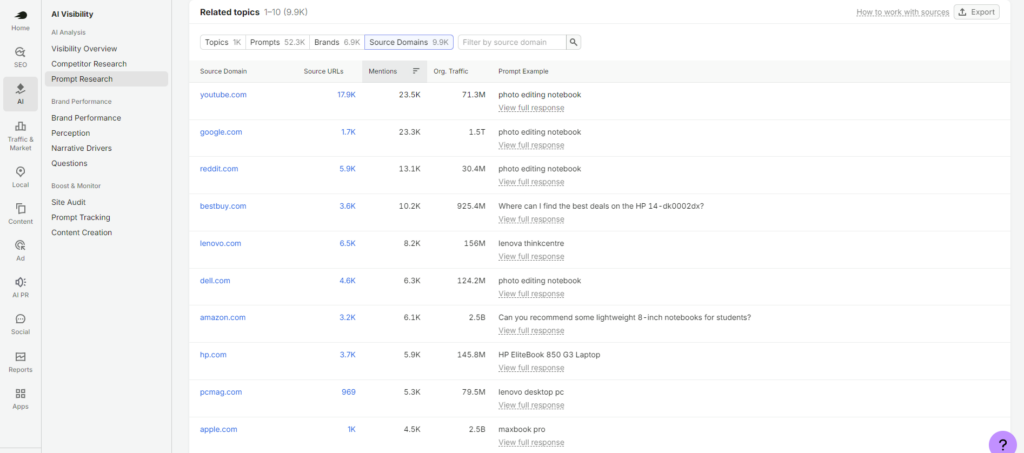
The AI answers also pull from a wider cast than brand websites. In Semrush’s prompt research, the most-mentioned brands for “best laptop” prompts were Intel, Lenovo, and HP, and the recurring sources were YouTube, Google, and Lenovo’s own site, with Reddit showing up for gaming. Chipmakers, video reviewers, and forums all compete with laptop brands for space in the answer.
This is why actually applying AEO and GEO can’t stop at “just add FAQs.” Sure, FAQs help. Structured content helps. Schema helps. Clean HTML helps. But if the broader internet does not associate your brand with the right buying decision, AI may still choose someone else.
How We Compared Google Rankings and AI Visibility
The brands: Apple, Lenovo, HP, Dell, ASUS, Acer, MSI, Samsung, LG, and Razer.
The seven searches, from broad to specific: “laptop,” “best laptop,” “laptop comparison,” “laptop for work,” “laptop for remote work,” “laptop for student,” and “laptop for gaming.”
For each brand and search, we recorded two things:
- SEO visibility: how many keywords containing that phrase the brand’s website ranks for on Google (Semrush Organic Rankings).
- AI visibility (AEO and GEO): how many AI prompts containing that phrase include the brand in the answer, mentioned or cited, across ChatGPT, Google AI Overviews, AI Mode, and Gemini (Semrush AI Visibility, Topics & Sources).
Keywords and prompts are different units, so we compare who ranks higher and lower, not the raw numbers. Still, the patterns are useful. And honestly, in SEO, AEO, and GEO, the directional patterns are often where the money is. You do not wait for perfect information. You look for the signal, then make the right strategic move.
The Big Picture: Domain Totals Say One Thing
Here are the domain-wide numbers.
Brand Worldwide organic keywords Worldwide AI mentions AI mentions as % of keywords AI Visibility score (/100) Apple 114.6M 7.4M 6.5% 79 Samsung 11.7M 1.6M 13.7% 84 HP 6.4M 426.7K 6.7% 71 Lenovo 4.4M 302.8K 6.9% 67 Dell 3.9M 343.5K 8.8% 63 ASUS 3.6M 334.6K 9.3% 66 LG 3.3M 412K 12.5% 64 MSI 1.1M 25.2K 11.4% 50 Acer 941.8K 103K 10.9% 52 Razer 474.1K 96.7K 20.4% 51
At this high level, Google footprint and AI footprint seem to move together. Apple and Samsung lead both columns, while Acer, MSI, and Razer trail both. Apple alone holds about 76% of the keywords and about 66% of the AI mentions among these 10 brands.
But these are whole-company numbers, and they hide a lot. Apple, Samsung, and LG sell phones, TVs, and appliances. And when we looked at the topics behind each brand’s AI mentions, many were not buying questions at all.
They were support topics: Apple laptop chargers, ASUS laptops not turning on, Acer warranty and registration, MSI screen replacement, Samsung drivers and troubleshooting.
Those count as AI mentions, but they are not recommendations. For the question that decides a sale, you have to look at the individual buying searches.
The Evidence: SEO Keywords vs. AI Prompts, Question by Question
Each cell in the table below shows Google keywords / AI prompts.
Brand “laptop” “best laptop” “laptop comparison” “laptop for work” “laptop for remote work” “laptop for student” “laptop for gaming” Apple 38.8K / 50.7K 355 / 2.7K 15 / 53 4 / 80 0 / 13 94 / 105 5 / 14 Lenovo 133.5K / 91.5K 3.9K / 3.2K 44 / 79 226 / 154 2 / 20 251 / 187 272 / 156 HP 308.1K / 93.4K 2K / 1.9K 46 / 46 113 / 98 0 / 9 257 / 99 287 / 117 Dell 267 / 68.3K 2.4K / 1.9K 76 / 49 189 / 64 5 / 15 240 / 88 268 / 73 ASUS 62.3K / 58.7K 539 / 2.3K 31 / 52 14 / 54 0 / 1 126 / 92 177 / 169 Acer 22.8K / 170 64 / 1.2K 19 / 0 2 / 31 2 / 2 32 / 102 48 / 91 MSI 11.3K / 12.2K 10 / 376 0 / 10 0 / 0 0 / 0 0 / 1 48 / 0 Samsung 3.3K / 9.7K 9 / 145 0 / 7 1 / 8 0 / 0 54 / 0 0 / 0 LG 2K / 628 6 / 39 0 / 4 2 / 3 0 / 0 0 / 1 0 / 0 Razer 2.6K / 5.5K 17 / 208 0 / 5 0 / 7 0 / 0 0 / 1 9 / 1
Our Findings
From this table, five patterns stood out. Some were expected. Others were surprising. And a few of them are exactly the kind of insight brands need to pay attention to because they show where SEO performance and AI visibility start to separate.
Finding 1: Where Google Strength Carries Into AI, the Brands Win Both
We compared each brand’s rank in Google keywords with its rank in AI prompts for each search. In every category the relationship was positive. It was strongest on the searches where buyers are choosing a product:
- “best laptop”: rank correlation of 0.88
- “laptop for work”: 0.83
- “laptop for gaming”: 0.76
- “laptop” (the head term): 0.65
- “laptop for student”: 0.60
- “laptop comparison”: 0.54
(1.0 would mean identical rankings.) Google rankings are a real predictor of AI visibility, but a loose one, especially for comparison and student searches. It matches with previous studies, where they found that LLMs like ChatGPT shared around 10-15% of cited websites as Google results.
Lenovo is the clearest double winner. It is first in Google keywords for “best laptop” (3.9K, with a pool that drives the most estimated traffic of any brand) and first in AI prompts for it (3.2K).
It is first in Google keywords for “laptop for gaming” (272) and second in AI prompts (156). It is second in Google keywords for the head term “laptop” (133.5K) and second in AI prompts (91.5K). It also leads AI prompts for comparison, work, remote work, and student searches. Its own site is among the top cited sources in the “best laptop” prompt data.
A brand’s own site showing up as a cited source is what strong SEO plus strong AI visibility looks like.
HP wins the head term in both worlds. It ranks for 308.1K “laptop” keywords and appears in 93.4K “laptop” AI prompts, the most of any brand in both. That is a massive footprint. It tells us HP has strong broad-category visibility.
When users search or ask broadly about laptops, HP is consistently present. For a brand, that is valuable because broad presence keeps you in the conversation before the buyer becomes more specific.
But broad visibility does not always translate perfectly into every specific buying use case. This is one of the lessons we will see later.
ASUS is first in AI prompts for gaming (169) and third in Google keywords for it (177), and it sits in the top three of both columns for “best laptop.”
This is strategically important because ASUS has a clear use-case association. Buyers, reviewers, and communities often connect ASUS with gaming and performance. AI systems seem to pick up on that. When the question becomes more specific, such as “laptop for gaming,” the brand’s use-case identity starts to matter a lot.
This is one reason use-case ownership is powerful. A brand that is known for something specific has an advantage when AI needs to recommend options for that specific need. In traditional SEO, you might still rank with a strong page. In AI visibility, you also need the broader market to understand what you are known for.
What Double Winners Usually Have
The brands that rank well on Google and also show up often in AI answers tend to have a few things in common. They have useful pages answering real buyer questions, broad keyword coverage across the buyer journey, strong brand recognition, consistent third-party discussion, and a clear connection to specific use cases.
This is why SEO and AEO should not be separated like two unrelated services. SEO builds the foundation. AEO and GEO build the recommendation layer on top of that foundation. When those layers work together, the brand has a better chance of ranking, being cited, and being chosen.
Finding 2: Strong SEO Does Not Guarantee Equal AI Visibility
Now here is where it gets interesting. The same table also shows brands whose Google strength did not fully carry over into AI answers.
This is where many companies will get surprised. They will say, “But we already rank.” And yes, maybe they do. But the better question now is: do they get recommended?
Dell is the clearest example. Among all 10 brands, it has the most “laptop for work” keywords (189) and the most “laptop comparison” keywords (76). It is second in “best laptop” keywords (2.4K) and second in “laptop for gaming” keywords (268).
On paper, that is very strong SEO. If we were only looking at Google keyword coverage, Dell would look like one of the best-positioned brands in the study.
But when we get to AI prompts, it is fourth for work (64) and comparison (49), outside the top three for “best laptop” (1.9K), and fifth for gaming (73). Lenovo, HP, and Apple beat it on work, and Lenovo and Apple beat it on comparison-related keywords.
So Dell had the pages. It had the keyword coverage. It had visibility. But AI did not reward it at the same level across these decision-stage prompts.
HP leads on “laptop for student” keywords (257), yet ranks fourth in AI prompts (99). Lenovo (187), Apple (105), and Acer (102) all outrank it. On “best laptop,” HP is third in keywords but only tied for fourth in AI prompts.
HP is clearly strong. But it does show that even strong brands can have specific AI visibility gaps. These gaps matter because AI answers often influence the shortlist. If a student asks an AI assistant which laptop to buy and HP is not consistently positioned as one of the best answers, HP may lose consideration before the user even reaches Google.
MSI is a clean example from the specialist side. It ranks for 48 “laptop for gaming” keywords, tied with Acer, but appears in 0 gaming prompts. Acer appears in 91. When we think of MSI as a brand, though, they are best known for their high-performance gaming laptops.
Acer ranks for 22.8K “laptop”-based searches on Google, and only shows up in 170 “laptop”-based prompts on AI search. Additionally, it ranks for 19 “laptop comparison” keywords yet appears in none of the comparison prompts we looked at. So, why the gap? The pattern shown by Dell, HP, and MSI’s AI search visibility suggests that brand association alone may not be enough. AI may need stronger reinforcement from answer-ready content, third-party comparisons, trusted reviews, and repeated use-case mentions across the web. One study by Profound found that most AI search engines mostly sourced their information from Reddit.
Finding 3: Some Brands Win AI With a Smaller SEO Footprint
The opposite also happens. Some brands appeared in AI answers more often than their Google keyword footprint would predict.
Apple ranks for just 4 “laptop for work” keywords, 15 “laptop comparison” keywords, and 5 “laptop for gaming” keywords, yet appears in 80 work prompts, 53 comparison prompts, and 14 gaming prompts. Its SEO is efficient rather than broad: 355 “best laptop” keywords bring about 24K in estimated traffic, versus 2K keywords bringing 6.2K for HP.
That is a big difference. Apple’s SEO footprint in those specific keyword sets was not broad, but its AI visibility was much stronger than the keyword counts alone would suggest. This likely reflects Apple’s strong brand recognition, consistent product positioning, loyal customer base, and wide presence across reviews and comparisons.
Acer ranks for only 32 “laptop for student” keywords but is third in AI prompts for that search (102), ahead of HP and Dell, which both have far more keywords. In gaming it has 48 keywords against Dell’s 268, yet 91 AI prompts against Dell’s 73.
Again, this tells us that AI visibility is not only about how many keywords you rank for. It is about whether the brand is understood as a good answer for the question being asked. If the market and the source layer consistently associate your brand with a use case, AI may include you even when your owned keyword footprint is not the biggest.
Dell ranks for only 267 “laptop” keywords, yet shows up in 68.3K “laptop” AI prompts, third highest. That suggests strong brand recognition may be doing work that keyword rankings alone are not doing for the head term.
This is another reason why raw SEO keyword counts cannot be the only visibility metric anymore. In AI search, the brand itself can become a signal. But that cuts both ways. If the brand is clearly associated with the right use case, AI may include it. If the brand is vague, under-explained, or mostly mentioned in support contexts, AI may skip it for buyer prompts.
Finding 4: Big Brand Strength Doesn’t Automatically Transfer to a Product Category
A company can be huge. A company can be incredibly famous – a household name. A company can have a strong AI Visibility score overall. And still not be strongly recommended for a specific product category.
Samsung has the highest AI Visibility score in the set (84) and 1.6M AI mentions in total. In laptop buyer prompts, it nearly disappears: 8 prompts for “laptop for work,” 7 for “laptop comparison,” and none for “laptop for student,” “laptop for remote work,” or “laptop for gaming.” It ranks for 54 student keywords on Google but appears in no student prompts.
That is the danger of relying on domain-level AI visibility. Samsung may be highly visible in AI overall, but that visibility may come from phones, TVs, appliances, troubleshooting, software, or support queries. That does not automatically help Samsung win laptop buying decisions.
LG ranks fourth in domain-level AI mentions, but its laptop footprint is thin on both sides. It has 2K “laptop” keywords and 6 “best laptop” keywords on Google, nothing meaningful on the other searches, and 628 “laptop” prompts and fewer than 40 on any specific search in AI.
That tells us LG’s AI mentions are likely coming from somewhere other than laptop buying questions. Again, the lesson is simple: overall AI visibility is not enough. You need buyer-intent AI visibility.
Razer appears in 5.5K “laptop” prompts and 208 “best laptop” prompts, but only 7 for work, 5 for comparison, and 1 each for student and gaming. This surprised us, because Razer is the brand most associated with gaming, and its domain-level ratio of AI mentions to keywords is the highest in the set. In the “laptop for gaming” data, the leaders were ASUS (169), Lenovo (156), HP (117), Acer (91), and Dell (73). Razer had 1.
That is a serious category gap. It does not mean Razer is not a gaming brand. Of course it is. But in this dataset, AI systems were not naming Razer often in “laptop for gaming” prompts.
In other words, being well known is not the same as being recommended for a specific purchase. This is why domain-level totals can mislead. They measure how often a company is talked about, including support questions, not how often it is recommended for a particular job.
Finding 5: The Biggest Gap Is Where Nobody Ranks
The “laptop for remote work” column is almost empty on the Google side. Only Dell (5 keywords), Lenovo (2), and Acer (2) rank for anything with that phrase, even though it is one of the largest keyword pools (18.4M in search volume). Yet AI already names brands for it: Lenovo in 20 prompts, Dell in 15, Apple in 13, and HP in 9.
This is a very important opportunity. AI answers are already filling the gap where Google rankings are underdeveloped. So if a brand builds a strong “best laptop for remote work” content hub, supports it with comparison content, and earns third-party validation, it may have a chance to win both SEO and AI visibility before the space becomes crowded.
This is where smart brands should move early. Do not wait until the SERP is already saturated. If there is buyer demand, AI prompt activity, and weak SEO competition, that is a strategic opening.
Why SEO and AI Visibility Don’t Always Match
Google decides what to show by matching a query to relevant, authoritative pages. AI answers are built by synthesizing information from many sources, then naming a few brands. That changes what helps:
- Google leans on keyword targeting, page relevance, backlinks, technical health, and search intent match.
- AI leans on consistent brand mentions across many sites, a clear match between brand and use case, comparison and “best for” content, third-party validation, and answer-ready page structure.
Ranking on Google helps AI visibility, because those pages are often what AI draws on. It doesn’t replace the extra signals AI looks for.
What the Brands That Win Both Do Differently
Looking at Lenovo, HP, and ASUS against the brands with gaps, a few patterns repeat. These are our reading of the data, not proven causes.
- They cover the whole buyer journey. They rank and appear across broad, comparison, and use-case searches, not just the head term.
- They own use cases. Lenovo shows up for work, student, and remote work. ASUS shows up for gaming. A brand with a clear place in a buyer’s mind gets named.
- Their own site is a source. Lenovo’s site is among the most cited sources for “best laptop” prompts.
- They don’t rely on brand alone. Samsung, LG, and Razer show that name recognition by itself leaves category gaps.
How to Run This Comparison in Semrush One
Here is the workflow we used. It works for any industry.
- Size the market. Use Keyword Magic Tool for the Google keyword pool and Prompt Research for the AI prompt pool, for each theme.
- Get the SEO side. In Organic Rankings for each domain, filter keywords by your target phrase (for example, “laptop for student”). Record the keyword count.
- Get the AI side. In AI Visibility, open Topics & Sources for each domain, switch to the Prompts view, and filter by the same phrase. Record the number of prompts where the brand appears.
- Compare rank, not size. Put the two numbers side by side and look at who ranks higher or lower.
- Check the gaps. Look for brands that lead in one column and trail in the other, and for questions nobody ranks for yet.
What to Do With This
- Keep investing in SEO. The brands that won both started with real keyword coverage across many buyer searches.
- Build for the question, not just the keyword. Create pages that answer “best laptop for remote work” or “Dell vs. Lenovo for business” directly, with a quick answer, who it’s best for, key criteria, a comparison, and FAQs.
- Own a use case. Decide what you want to be recommended for and say it consistently on your site and elsewhere.
- Earn mentions outside your own site. Reviews, video coverage, forum discussion, and comparison sites are what AI draws on for recommendations.
- Separate buying visibility from support visibility. Check which AI topics your brand appears in. Troubleshooting mentions don’t win shortlists.
- Fill the white space. Where no one ranks (like remote work), a good page can win on both sides at once.
- Track share of voice. Measure how often you appear across a fixed set of buyer prompts, alongside rankings and traffic. AI answers often mention a brand without a click, so traffic alone undercounts.
Author’s Note: I cover how to do all of the above (and more) for your website in my AEO and GEO series, starting with my guide on AI overviews, zero-click search, and what to do about it.
Data Summary
- Google keyword strength and AI prompt presence move together in every search we looked at, most strongly on “best laptop,” “laptop for work,” and “laptop for gaming,” and least on comparison and student searches.
- Lenovo, HP, and ASUS lead because they do both: wide keyword coverage and wide AI presence.
- Dell, HP, MSI, and Acer have Google coverage in some searches that doesn’t carry over to AI. MSI ranks for 48 gaming keywords and appears in no gaming prompts.
- Apple and Acer get more AI visibility than their keyword counts predict.
- Samsung, LG, and Razer have big or well-known brands but little visibility for specific laptop buying questions, and much of their AI mention volume comes from support topics.
- The least-contested ground is where no one ranks yet, like “laptop for remote work.”
Key Takeaway
Google keyword strength and AI prompt presence are connected. In every search we looked at, the relationship was positive. That means SEO still plays a very important role in AI visibility, especially when the search is tied to buying intent.
However, ranking on Google and getting recommended by AI are two different jobs. The data shows they overlap, and the brands that handle both come out ahead. The brands that handle only one leave buyers on the table.
SEO gets you found, clicked, and trusted. AI visibility gets you named when someone asks for a recommendation. The brands that win the next phase of search will be the ones that rank for the keywords and answer the questions.
Want to know whether your brand shows up when buyers ask AI for recommendations, and how that compares to your Google rankings? SEO Hacker can measure both and build a plan to close the gaps.
Frequently Asked Questions About Ranking on Google and AI Search
Do brands that rank on Google also show up in ChatGPT?
Often, yes. In our laptop data, brands with stronger Google keyword footprints usually had stronger AI visibility too. But the relationship was not perfect. Some brands ranked well on Google but appeared less often in AI answers for the same buyer-intent topics.
Can a brand have strong SEO but weak AI visibility?
Yes. Dell is a good example from this dataset. It had strong Google keyword coverage for several themes, including “laptop for work” and “laptop comparison,” but did not lead AI visibility for those same searches.
Can a brand be visible in AI without ranking well on Google?
Yes. Apple ranked for only 4 “laptop for work” keywords in this dataset but appeared in 80 AI prompts for that same search theme. This suggests that brand strength, third-party validation, and clear product association can influence AI visibility beyond keyword count alone.
Does being a famous brand guarantee AI recommendations?
No. Samsung had the highest AI Visibility score among the brands we studied, but it appeared in very few laptop buyer prompts. Big brand visibility does not automatically transfer to every product category or use case.
Why do AI answers and Google rankings differ?
Google usually ranks pages based on relevance, authority, technical SEO, content quality, links, and intent match. AI answers synthesize information from many sources and may prioritize brands that are consistently associated with a specific use case across the web.
Where do AI answers get their information?
AI answers can draw from brand websites, review sites, YouTube, forums, Reddit, comparison articles, publisher content, and other accessible sources. In this laptop study, recurring sources included YouTube, Google, Lenovo’s own website, and Reddit for some gaming-related prompts.
What is the difference between SEO, AEO, and GEO?
SEO, or Search Engine Optimization, focuses on ranking in search engines for target keywords.
AEO, or Answer Engine Optimization, focuses on answering user questions clearly so your content can appear in AI answers, featured snippets, and other answer-based experiences.
GEO, or Generative Engine Optimization, focuses on improving your brand’s chances of being cited, mentioned, or recommended by generative AI systems.
The three work best together.
Should brands stop doing SEO and focus only on AI visibility?
No. SEO is still the foundation. Google still matters, and strong SEO can support AI visibility. The better strategy is to keep investing in SEO while adding AEO and GEO layers so your brand can rank in search results and appear in AI-generated recommendations.
How should brands measure AI visibility?
Track share of voice across a fixed set of buyer-intent prompts. Measure how often your brand appears, how often competitors appear, whether your brand is cited, which sources are used, and whether AI referrals show up in GA4. Also watch branded search lift and assisted conversions.
Why is traffic alone not enough to measure AI visibility?
Many AI answers mention brands without links. If the user sees your brand in an AI answer and later searches for you directly, that influence may not appear as an AI referral in analytics. This means GA4 can show part of the picture, but it may undercount the true impact of AI visibility.
What type of content helps with AEO and GEO?
The strongest content usually answers specific buyer questions directly. Useful formats include comparison pages, “best for” pages, use-case pages, alternatives pages, product decision guides, FAQs, pricing explainers, and proof-led service pages. These should include clear answer blocks, decision criteria, examples, internal links, and structured data where appropriate.
What is the biggest opportunity from this study?
The biggest opportunity is to find buyer-intent topics where demand is high but content coverage is weak. “Laptop for remote work” was one example. When few brands rank but AI prompts already exist, a strong content asset can potentially win visibility in both Google and AI answers.
The post SEO Rankings vs. AI Visibility: Do the Brands Ranking on Google Also Win in ChatGPT? appeared first on SEO Services Agency in Manila, Philippines.


