



What happens to your website when Google answers the question before anyone clicks?
A new field experiment gives us a controlled look at exactly that. Researchers from the University of Pennsylvania and Northeastern University tracked 1,100 Google users for a week in a preprint titled: “AI in Search Reduces Publisher Referrals Without Improving User Experience.”
People forced into AI Mode clicked through to external websites 18.8 percentage points less often than people on regular Google. They also reported lower trust, usefulness, and satisfaction, and more of them turned to Bing, DuckDuckGo, or Yahoo.
So Google can show your brand in more places, send fewer people to your website, and still not leave users any happier. That’s the disconnect. The real question isn’t whether AI search is good or bad. It’s what you should do when being visible no longer guarantees being visited.
Quick Answer
Stop treating clicks as the only proof that search is working. Track visibility, visits, and business results separately. Build pages that give people a reason to click after an AI answer. And measure AI visibility against a baseline, using queries your customers actually ask, before you credit any strategy for the results. None of this means abandoning SEO.
1. Search Visibility No Longer Guarantees Website Traffic
For years, rankings, impressions, and clicks moved more or less together. Rank higher, get seen more, get visited more. AI-generated answers break that chain.
In the experiment, people in AI Mode spent more time per search session, but they started fewer sessions and visited fewer outside websites. A page can inform the answer. A brand can be named in it. And the website can still get nothing.
That’s why I’d separate three things we tend to lump together: being visible, getting visited, and generating business results. They’re related, but they’re not the same. A report that tracks only one of them will mislead you.
Before you blame your CTR loss on AI overviews and other AI-powered search experience, though, check your own data. If impressions are steady but clicks are falling, AI answers are a reasonable suspect. If impressions are falling too, you may simply have lost rankings. Compare impressions and clicks page by page in Google Search Console before you change your strategy.
This is also why SEO, AEO, and GEO shouldn’t be treated as competing options. They’re different layers of the same job. SEO gets you found, AEO makes your answers clear, and GEO supports whether AI systems mention you at all. If you want an in-depth breakdown on these topics, here’s AEO vs. GEO, and here’s why SEO isn’t dead.
What to track side by side:
- Organic rankings, impressions, CTR, and conversions.
- AI brand mentions and citations.
- Competitor visibility on the same queries.
- The impressions-to-clicks trend for your key pages.
That’s the problem tools like Rankseer are built around. Rankseer brings traditional SEO monitoring and AI search visibility tracking into one place, so you can see where you rank on Google, how often AI platforms mention your brand, and how that compares with your competitors.
2. Give Users a Reason to Visit Your Website
AI answers handle simple informational questions well. What is canonicalization? What does CTR stand for? If your page offers only that kind of answer, a summary can do the same job without a visit.
Here’s the uncomfortable question. If an AI-generated response can summarize everything your article offers, what incentive does anyone have to visit your website?
The study hints at part of the answer. In the survey, among the most common complaints about AI Mode were feeling less in control, having trouble reaching specific websites, and seeing too few links or sources (Relevant Audience’s write-up breaks these down). Some people don’t want to stay in the summary. They want the source. Your job is to be a source worth reaching.
I’d think about it as optimizing for the next question, not just the first one. The AI handles the first question. The next ones are where a website earns the visit: Which option fits my budget? How would this work for my business? Can I see an example?
That changes how I’d prioritize pages:
- Audit high-impression informational pages. If impressions are strong and CTR is weak, ask what a reader gets from the page that a summary can’t provide.
- Invest in what summaries can’t easily replace. Original research, case studies, comparisons, templates, tools, pricing explanations, and firsthand expertise.
- Weigh intent next to volume. A smaller keyword that attracts someone ready to decide can be worth more than a large one an AI will answer for them. This is where prompt research helps.
- Move readers from learning to deciding. Every informational page should point to a logical next step.
A hypothetical example: a page that only defines “schema markup” competes with every AI summary on the internet. A page that includes a schema audit checklist and examples readers can copy gives them a reason to click.
3. Search Visibility Is Becoming Harder to Measure
AI search adds layers that traditional reports weren’t built to see. These terms get mixed up, so here they are separately:
- A mention is when an AI answer names your brand.
- A citation is when an AI answer links to or lists your page as a source.
- A visit is when someone actually lands on your website.
- A conversion is when that person takes the action you care about, such as an inquiry, a purchase, or a signup.
You can have the first without the rest. Someone may see your brand in an AI answer, never click, search your name a week later, or call you directly. Your analytics may credit that to branded search, direct traffic, or nothing at all. That’s why AI referral traffic alone will usually undercount AI’s influence.
This is where AI Share of Voice is useful. It measures how often AI answers mention your brand compared with your competitors, across a fixed set of tracked prompts. Rankseer tracks this, and the math is simple. Here’s an example with made-up numbers:
Suppose you track 40 buyer-intent prompts, and the AI answers produce 40 brand mentions across you and two competitors.
| Brand | Mentions | Share of Voice |
|---|---|---|
| Your brand | 10 | 25% |
| Competitor A | 18 | 45% |
| Competitor B | 12 | 30% |
| Total | 40 | 100% |
Share of Voice = your mentions ÷ total mentions across all tracked brands × 100.
Here’s a sample of what that looks like in a historical graph:
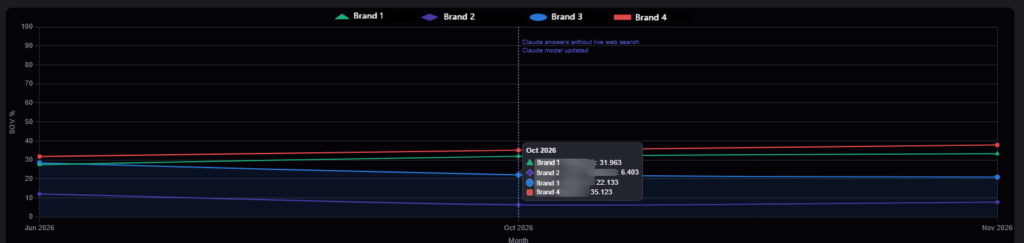
The point of doing this isn’t just knowing you have an AI SOV of 25%. It’s the comparison. You’re no longer asking only “where do I rank?” You’re asking “how visible am I, compared with the brands my customers might be shown instead?” We ran a version of this in our laptop brands study, and I walk through how to track your brand across AI platforms separately.
Keep in mind: most AI search tools calculate this differently, and AI answers vary by model, prompt wording, and location. I suggest treating AI SOV as a directional metric, not an exact one.
What to do:
- Monitor how often AI platforms mention and cite your business.
- Compare your visibility against relevant competitors on commercially meaningful queries.
- Track AI referral traffic and branded search trends next to traditional organic performance.
- Add “How did you hear about us?” to your inquiry forms. It’s a low-tech way to catch search discovery that analytics misses.
4. Are We Measuring AI Search Success Too Early?
Here’s the part the industry doesn’t love to hear. Mentions, citations, and Share of Voice feel like progress. A dashboard that moves from 8% to 15% looks great in a report. But does it mean more customers?
Not necessarily. A higher AI Share of Voice is useful information. It isn’t proof of more revenue, more customers, or better marketing ROI. It matters even less if the visibility comes from the wrong queries. In our laptop study, many of the big brands’ AI mentions came from support questions, like troubleshooting and warranties, not buying questions. Those count as mentions. They don’t win shortlists.
Baselines matter too. AI answers shift with the model, the prompt, and the person asking. If you don’t measure before you start optimizing, you can end up crediting your campaign for movement that was just noise.
A practical way to approach it:
- Set AI visibility benchmarks before you launch any optimization campaign.
- Prioritize queries that reflect real customer needs and buying decisions.
- Watch AI visibility alongside branded search demand, organic engagement, and conversions.
- Judge SEO, AEO, and GEO investments by their contribution to business goals, not just visibility growth.
So if AI visibility becomes the next major marketing KPI, how do we keep it from becoming another vanity metric? My answer: tie it to queries your customers actually use, and keep asking whether it connects to leads and revenue. Even the study behind this article measured clicks, sessions, and user perceptions. It can’t tell you what happens to your leads.
Key Takeaway
AI-powered search is changing the relationship between visibility, traffic, and business value. A brand can be seen more and visited less. That doesn’t make traditional SEO less important. It’s still the foundation that most of this visibility is built on. AEO and GEO add new chances to be discovered, but they’re only worth the effort when they bring the right customers closer to a decision.
So optimize for meaningful discovery, not visibility alone. Build a baseline, track the queries that matter to your customers, and adjust based on evidence instead of industry hype.
The goal of SEO, AEO, and GEO shouldn’t simply be to make your business more visible. It should be to help the right customers find you, get useful information, and take meaningful action.
Frequently Asked Questions About AI Search and Website Clicks
Does Google AI Mode really reduce clicks to websites?
In one preregistered experiment, yes. Forcing searches into AI Mode lowered click-through to external websites by 18.8 percentage points compared with regular Google. But the study ran for seven days with US participants who were forced into AI Mode, so it shows direction. It doesn’t predict what every site will see.
Should I stop investing in SEO because of AI Mode?
No. In our own laptop-brand comparison, Google keyword strength and AI visibility moved together in every search we looked at, although loosely. SEO is still the foundation. AEO and GEO are layers you add on top of it, not replacements.
What is AI Share of Voice?
AI Share of Voice is the percentage of brand mentions in AI answers that belong to your brand, compared with a set of tracked competitors, across a fixed list of prompts. It’s a directional measure of competitive visibility, not a measure of revenue.
How can I tell if AI is behind my traffic drop?
Start with Google Search Console. If impressions are steady while clicks and CTR fall, AI answers are a likely factor. If impressions are falling too, check rankings, seasonality, and technical issues first. Search Console alone can’t prove the cause, so treat it as a starting point for investigation.
The post Google AI Search Is Reducing Website Clicks. What Should You Do About It? appeared first on SEO Services Agency in Manila, Philippines.


